
Every clinic page for this treatment says something like backed by clinical studies. That is technically true, and it is where most readers stop. The useful questions are what kind of studies, funded by whom, how many patients, and compared against what. All four are answerable in an afternoon for Morpheus8, because the published literature is unusually small. So this is not an article about whether the device works on jowls or acne scars. It is about how to read the claim.
The whole literature fits on one page
A PubMed search for Morpheus8 returns approximately 16 indexed records. Sixteen, for a device marketed continuously since 2020 and surrounded by thousands of pages of promotional copy.
Sixteen is not nothing; plenty of useful devices have small literatures. But it caps what anyone can honestly claim. The phrase multiple published studies sounds like a body of work; here it is a stack you could read over a weekend, in which some records are reviews of the others and one of the largest datasets appears twice under two titles, reporting the same patients.
Level of Evidence 5 is the bottom of the scale, not the top
When researchers grade evidence, they rank a study by its design rather than its result. The strongest designs sit at level 1, the weakest at level 5. Level 5 is the floor: expert opinion, case reports and uncontrolled series, which record what happened to a group of patients without establishing what caused it.
The only independent systematic review of radiofrequency microneedling rates the entire body of evidence at Level of Evidence 5.
Three things about that review matter as much as the rating. It excluded industry-funded studies. It applied the Cochrane risk-of-bias tool, a standard method for judging how far a design could have distorted a finding. Its authors declared no conflicts of interest and no funding. It is the paper here with the least reason to reach a convenient answer.
Two things it does not mean. It does not mean the treatment does nothing: it means the available studies cannot settle the question either way. And it is not a score out of five. Anyone who sees Level of Evidence 5 and hears five stars has it exactly inverted.

What a sham-controlled trial is, and why its absence matters
A sham-controlled trial is the procedural equivalent of a placebo tablet. Half the participants receive the real treatment. The other half go through an experience built to be indistinguishable from it: same room, same consultation, same handpiece against the skin, no active energy delivered. Ideally nobody scoring the results knows which group anyone was in.
The design exists because of everything else that changes when a person has a procedure. They have paid for it, often four figures. They have been told to expect gradual improvement, so they look for it. The follow-up photograph is taken in different light, with better posture. Skin varies week to week anyway. A sham arm holds all of that constant, so what is left over can fairly be credited to the energy.
No sham-controlled randomised trial of Morpheus8 has been published. Nothing separates the effect of the device from the effect of the experience around it, which is why the field sits where it does on the scale, and why no honest page can call this treatment proven.
Who paid for the studies, and why it is printed on the page
Journals require authors to declare their funding and financial relationships. Those declarations sit in small type at the end, where nobody reads them. Here they are the most informative paragraph in the paper.
A large share of the published Morpheus8 work appears in journal supplements sponsored by InMode and written by InMode consultants: the flagship datasets on jowls and neck laxity, the work on acne and acne scarring, and the review most often cited for how the device works. A supplement is a separately funded issue attached to a journal, commonly paid for by a company with an interest in the subject, and not necessarily subject to that journal’s ordinary editorial process.
Now the fair part, which matters more than the criticism. None of this makes the findings wrong. Sponsored research is normal in medical devices, and these are real patients. Sponsorship is a reason to weigh a result carefully, not to bin it.
The omission is the unfair step. When a page says multiple published studies support this treatment, without saying who funded the supplement and employed the authors, you are handed the reassurance of independence without the independence.
The evidence, indication by indication
| Indication or question | Best available evidence | Patients | Independence |
|---|---|---|---|
| Face and neck laxity | 2019 and 2020 retrospective series | 247, counted twice | InMode-funded, authors consultants |
| Laxity after a facelift | 2021 prospective study | 9 completed | Same research group |
| Facial safety | 2025 retrospective safety review | 364 treated zones | Journal supplement |
| Acne and acne scars | 2025 retrospective comparison | 139 treated | InMode-sponsored supplement |
| Neck wrinkles against a laser | 2022 randomised comparison | 21 | Independent, device lost |
| Cellulite | 2022 case series | not retrievable | InMode-linked supplement |
| Body, combined with nanofat | 2025 retrospective series | 20 | No financial interest declared |
| Fat loss as a harm | 2025 review of face and neck lifts | 180 | Fully independent |
| Stretch marks | none | none | none |
| Against a sham control | none | none | none |
Read the last two columns before the first two. The biggest numbers sit beside the weakest independence, and the only fully independent entries are a comparison the device lost and a finding of harm.
The longest peer-reviewed follow-up averages 2.1 years, from the sponsor-funded retrospective that counted that cohort a second time, and no controlled durability data exist. The claim that results last one to three years traces to clinic marketing, not to any study, worth carrying into a conversation about how many sessions to expect.
The one comparison that exists, and the one that does not
Exactly one independent randomised comparison of radiofrequency microneedling against another modality has been published: 21 patients, three treatments four weeks apart, against a 1550 nm non-ablative fractional laser on the neck. The laser won the headline measure, 42.1 percent improvement on wrinkle score against 8.6 percent, and won on elastosis too. Radiofrequency microneedling did better on one scale, and 21 patients is a small trial. It is still the only independent randomised evidence in the field, and it did not go the way the advertising does.
The comparison that does not exist is the one clinics make most often. No head-to-head trial of Morpheus8 against another radiofrequency microneedling brand has been published: not against Potenza, Genius, Secret RF or Vivace. Claims that this machine beats those machines are not claims about evidence, because there is none either way. Needle depth is a real technical differentiator; a design difference is not a demonstrated clinical advantage.
The mechanism is described, not measured
The standard explanation is that heating soft tissue to roughly 50 degrees Celsius induces collagen and elastin production along with angiogenesis, the growth of new small blood vessels. That comes from a review article. No histological study specific to Morpheus8, quantifying how much remodelling occurs and at what depth, has been published. The mechanism you are talked through is a description, not a measurement.
What a before and after photograph is evidence of
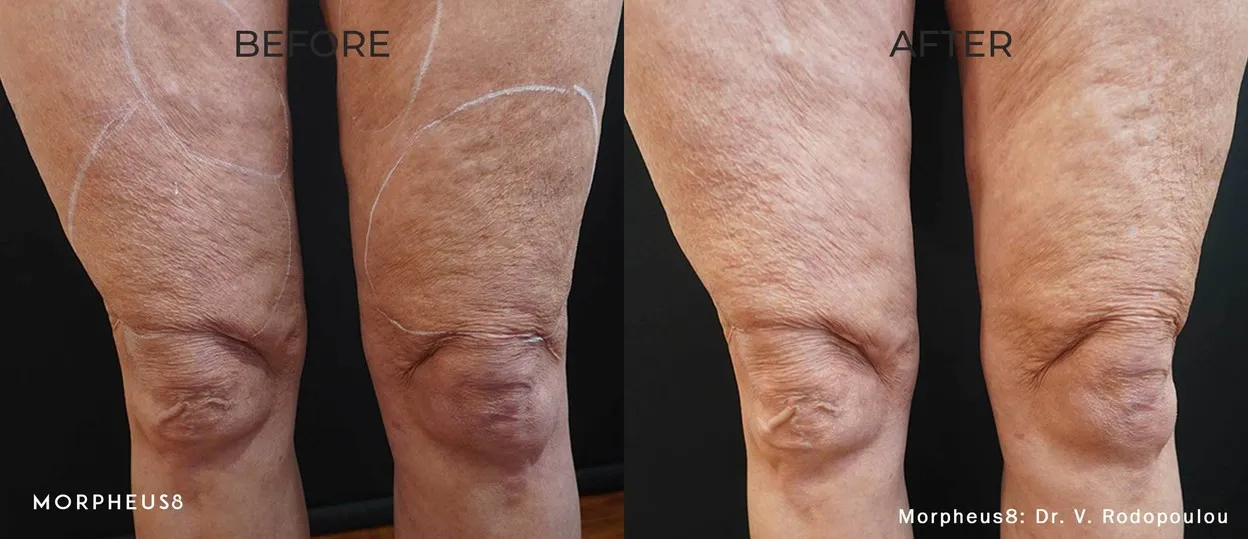
Before and after pairs are the most persuasive material in aesthetics and the weakest evidence in it.
A pair of photographs has no control, no blinding and no denominator: you cannot see how many patients were photographed and not shown, and lighting, angle, posture and time of day move an apparent result further than most people expect. The pair below is the manufacturer’s own, showing one patient treated by one named physician. It is not a patient of ours and not an average, so read it as an illustration of what a good outcome can look like, not as evidence of what yours will be.
The paperwork counts as evidence too
One category of hard fact sits outside the study literature entirely.
Morpheus8 is 510(k) cleared, not FDA approved. Clearance is a substantial equivalence pathway in which a manufacturer shows a device is close enough to one already on the market. It is not a finding that it works. No Morpheus8 clearance names wrinkles, skin tightening, acne scars, cellulite, stretch marks, body contouring or fat reduction: the cleared wording covers electrocoagulation, haemostasis, and coagulation or contraction of soft tissue. We go through it line by line in what the clearance actually says.
On 15 October 2025 the FDA published a safety communication on radiofrequency microneedling reporting burns, scarring, fat loss, disfigurement, nerve damage and the need for surgical repair, and stating that radiofrequency microneedling is a medical procedure, not a cosmetic treatment. Those documents are written by people with no commercial stake in the answer.
How to read the next claim you see
Four questions do most of the work. Who funded the study, and who employed its authors. What was actually treated, since the largest dataset here combined Morpheus8 with two other devices. How many patients, and whether they have been counted before under another title. And what it was compared against.
Applied to Morpheus8 those questions give a narrower answer than the advertising, though not an empty one. Something is happening in treated tissue, and the largest safety review found no scarring or pigment change across several hundred treated facial zones. What does not exist is proof, in the sense the word carries on a clinic page.
So you are deciding under uncertainty, which is normal in aesthetics and rarely said out loud. Book a consultation with us and we will say which claims about your concern rest on something, which do not, and whether another treatment has better evidence behind it. If what is bothering you needs a diagnosis rather than treatment, we will send you to a GP or dermatologist first.
At a glance
The evidence base itself, weighed honestly
+ Reasons in favour
- The literature is small enough to read: roughly 16 indexed records, each one printing its own funding and conflicts of interest, so any claim made to you can be checked at source
- A 2025 retrospective safety review covering 364 foreheads, 364 periorbital areas, 353 perioral areas and 233 jawlines reported no hyperpigmentation, hypopigmentation, scarring or prolonged erythema
- One 2025 body series of 20 patients was published by authors declaring no financial interest, which is rare in this literature and counts for more than its size suggests
− Reasons for caution
- The only independent systematic review, which excluded industry-funded studies and applied the Cochrane risk-of-bias tool, rates the whole radiofrequency microneedling evidence base at Level of Evidence 5, the lowest tier on the scale
- No sham-controlled randomised trial of Morpheus8 has been published, so nothing separates what the device does from what any expensive, anticipated procedure does
- The flagship datasets appear in journal supplements sponsored by InMode and were written by InMode consultants, and the largest of them reported the same 247 patients twice under two titles
Frequently asked questions
The short version.
01Does Level of Evidence 5 mean Morpheus8 does not work?
No, and this is the most common misreading. A level of evidence rating describes the design of the studies, not the result they found. Level 5 is the bottom of the scale: expert opinion, case reports and uncontrolled series, which describe what happened to a group of patients without being able to establish what caused it. So the rating means the question has not been settled either way. It is not a score out of five, and it is not a verdict that the treatment is useless.
02What is a sham-controlled trial, and why does it matter?
It is the procedural equivalent of a placebo tablet. Half the participants get the real treatment and half go through an experience built to feel the same, in the same room with the same handpiece against the skin, without the active energy being delivered. Ideally neither the participants nor the people scoring the photographs know who got which. It matters because expectation, expense, better lighting, new skincare habits and ordinary week-to-week variation all move a cosmetic result. A sham arm holds those constant so that what is left over can fairly be credited to the device. No sham-controlled trial of Morpheus8 has been published.
03Are the Morpheus8 studies fake or dishonest?
No, and it would be unfair to say so. They are real data about real patients, collected by experienced clinicians, and the funding is disclosed inside the papers rather than hidden. Manufacturer-sponsored research is normal across medical devices. The problem is not the studies but the way they are cited: describing them as multiple published studies while omitting that the manufacturer funded the supplement they appeared in, and employed the authors as consultants, gives a reader the reassurance of independence without the independence.
04Has Morpheus8 been shown to work better than other radiofrequency microneedling devices?
No head-to-head trial of Morpheus8 against another radiofrequency microneedling brand has been published, so there is no evidence either way. Morpheus8 does have a genuine technical differentiator in needle depth, since most rival devices stop around 3.5 to 4 mm, but a design difference is not the same as a demonstrated clinical advantage. Any clinic telling you this machine outperforms a competing machine is describing a preference, not a finding.
05Is there any fully independent evidence about Morpheus8 at all?
Yes, three pieces. A 2022 randomised comparison on the neck, in which a 1550 nm non-ablative fractional laser outperformed radiofrequency microneedling on wrinkle score. A 2025 retrospective series of 20 body patients whose authors declared no financial interest, although it combined the device with nanofat grafting. And a 2025 review of 180 face and neck lifts by surgeons declaring no funding and no conflicts, which is a finding of harm rather than benefit: they described subcutaneous fat loss in areas corresponding to prior needle penetration.