
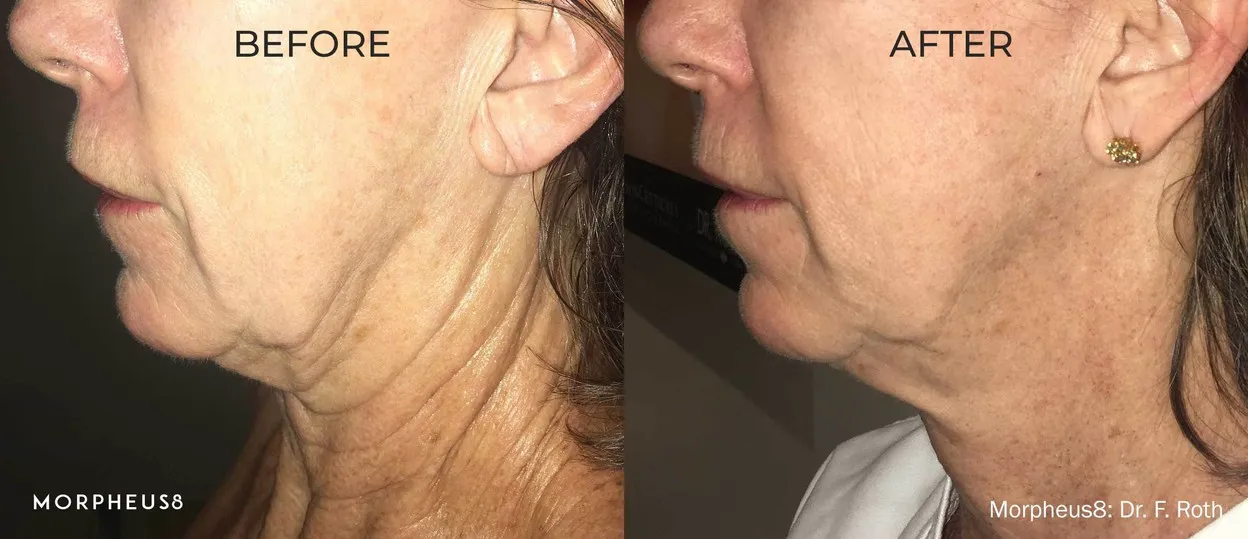
Jowls, a softening jawline and a loose neck are what Morpheus8 is mostly sold for. This is the before and after you have already seen: a jaw angle redrawn, a neck line tightened, usually captioned as the thing to do instead of surgery. It is also the indication where the distance between the marketing and the published record is widest.
So here is what the evidence actually supports for the lower face and neck. Parts of it are more encouraging than sceptics allow. The parts quoted most often do not say what they are usually said to say.
The evidence for this area, at a glance
| The study | Patients | What was actually treated | Independence |
|---|---|---|---|
| 2019 retrospective, the flagship dataset | 247 | Morpheus8 with FaceTite or BodyTite | InMode co-funded supplement, all authors InMode consultants |
| 2020 retrospective | the same 247, again | the same combination | All authors InMode consultants |
| 2021 prospective, laxity after a facelift | 9 completed | Morpheus8 with AccuTite | Same research group |
| 2025 zone-by-zone safety review | 233 jawlines | Morpheus8 | Journal supplement |
| 2022 randomised neck comparison | 21 | Radiofrequency microneedling against a 1550 nm laser | Independent |
| 2025 review of face and neck lifts | 180 | Prior treatment, found at surgery | Independent, no funding, no conflicts |
Read the third column before the fourth. This is a thinner and more entangled evidence base than the one behind acne scarring, where one retrospective series ran to 139 patients treated with radiofrequency microneedling alone.
The dataset everyone quotes tested a combined procedure
The flagship Morpheus8 dataset is a 2019 retrospective series of 247 patients, 224 women and 23 men, mean age 55 with a range of 26 to 67, treated for neck laxity and jowling. Almost every number quoted for this area comes from it. On the Baker Face/Neck score, a physician-rated scale of facial and neck ageing, patients improved by a mean of 1.4 points from a pre-treatment 3.1, and 93 percent were recorded as pleased.
Now the sentence that rarely travels with those figures. Those 247 patients were treated with Morpheus8 combined with FaceTite or BodyTite, InMode’s bipolar radiofrequency devices for radiofrequency assisted lipolysis. Not Morpheus8 on its own. The study cannot separate the contribution of one device from the other, because nobody in it received one without the other.
That single fact disqualifies the study as evidence for Morpheus8 used alone, which is how it is almost always cited.
The complications from the same paper belong next to the benefits: swelling persisting beyond six weeks in 4.8 percent, hardened areas beyond twelve weeks in 3.2 percent, and neuropraxia, a temporary nerve palsy, in 1.2 percent. The protocol was 1 to 3 sessions, 3 to 6 weeks apart, with 2 to 5 days of downtime reported. The manufacturer’s own operator manual is less optimistic, describing oedema and crusting resolving over 1 to 3 weeks.
Then the funding. The journal supplement was co-funded by InMode and all of its authors were InMode consultants. That does not make the findings wrong, but citing multiple published studies without saying so leaves out something material.
The second paper is the same patients again
A 2020 multicentre retrospective, reported as the Embrace Protocol, is routinely presented as confirmation. It records Baker scores falling from 2.66 to 1.86, a mean difference of 0.81, with an average follow-up of 2.1 years.
It is largely the same 247-patient cohort, reported again, and all of its authors were InMode consultants. A second publication is not a second study, and this is not independent replication. Two papers, one group of patients, one funding source, the same combination of devices.
The 2.1 year follow-up is still the longest this treatment has in peer review. It is also uncontrolled, so it records what happened to a group of patients, not what the treatment caused.

What the regulator has and has not said
Morpheus8 is 510(k) cleared, not FDA approved. Clearance is a substantial equivalence pathway: a manufacturer shows a device is broadly like one already on the market. It is not a finding that the device works.
No Morpheus8 clearance names wrinkles, skin tightening, acne scars, cellulite, stretch marks, body contouring or fat reduction. The cleared wording covers dermatologic procedures where coagulation or contraction of soft tissue, or haemostasis, is needed. Jowls and neck laxity appear nowhere in it.
On 15 October 2025 the FDA published a safety communication on radiofrequency microneedling, reporting burns, scarring, fat loss, disfigurement, nerve damage and the need for surgical repair, and stating plainly that radiofrequency microneedling is a medical procedure, not a cosmetic treatment.
And no sham-controlled randomised trial of Morpheus8 exists. The one independent systematic review that excluded industry-funded studies rates the whole radiofrequency microneedling evidence base at Level of Evidence 5, the lowest tier. That is the backdrop to every figure above, and it is set out further in what the evidence base as a whole looks like.
The one independent randomised comparison is on the neck
Exactly one independent randomised comparison of radiofrequency microneedling against another modality has been published, and it happens to be on this area. Twenty-one patients received three treatments four weeks apart, comparing it with a 1550 nm non-ablative fractional laser on the neck.
The laser won the two headline measures. On the Fitzpatrick-Goldman Wrinkling Score, improvement was 42.1 percent for the laser against 8.6 percent for radiofrequency microneedling. On elastosis, it was 41.3 percent against 16.3 percent. There was also a trend towards higher patient satisfaction with the laser.
Radiofrequency microneedling did do better on one measure, the Horizontal Neck Wrinkle Severity scale, so this is not a rout. And 21 patients is small, testing one wavelength against one radiofrequency protocol.
It is still the only independent randomised evidence in the field, and it says that on the neck this technology is not automatically the stronger choice against established laser resurfacing.
The finding that should change the conversation
The most important paper for anyone considering the lower face and neck is not a Morpheus8 study at all. It is a 2025 review of 180 face and neck lifts, by surgeons declaring no industry funding and no conflicts of interest.
Of those 180 patients, 123, or 68 percent, had had some prior neck intervention, 37 of them non-surgical. Operating on them, the authors found a layer of fibrosis between the skin and the superficial cervical fascia. They name Morpheus8 specifically among the deeper-penetrating devices, describing irregularities related to greater subcutaneous fat loss in areas felt to correspond to where the needles had gone in.
Loss of subcutaneous fat made achieving a smooth cervical contour, in their words, exceptionally difficult if not impossible. The risk of submental skin loss went up. A deep neck lift was required in 91 percent of cases, and contour irregularities were seen in nearly 100 percent.
One more detail deserves repeating: five patients, 4 percent of the series, had not told their surgeon about prior non-surgical treatment. If you have had radiofrequency microneedling and you later see a surgeon, say so.
That review predates the FDA’s October 2025 communication and independently corroborates the fat loss signal in it. How depth and treatment area change this risk is covered in how the body and face protocols differ.
The claim to be most careful with
Put those two independent findings side by side and a very common piece of marketing collapses. Describing this treatment as a non-surgical alternative to a facelift fails twice over: the dataset behind the claim is of a combined procedure rather than Morpheus8 alone, and the independent surgical literature reports that prior deep treatment makes later correction harder rather than unnecessary. It is a claim we do not make.
It is worth remembering what a photograph is and is not. The studies above measured outcomes with physician-rated scales such as the Baker Face/Neck score, because a single pair of images cannot be scored, standardised or compared between patients.
What the evidence does support
Take out everything that does not hold, and something is still standing.
A 2025 zone-by-zone retrospective safety review recorded Morpheus8 treatment of 233 jawlines, among other facial areas, with no cases of hyperpigmentation, hypopigmentation, scarring or prolonged erythema. It appeared in a journal supplement and measured safety rather than effect, but that is a substantial volume of treatment in this region without those complications.
A small prospective study looked at jowl and neck laxity returning 1 to 5 years after a facelift, treated with Morpheus8 and AccuTite. Only 9 patients completed the protocol, which is the first thing to say next to any number from it. Among those 9, blinded investigators rated 33 percent markedly improved at three months, rising to 55 percent at six months, with no adverse events recorded.
Real signals, then, in small numbers, and no controlled trial anywhere in the set. Patients in uncontrolled series report being pleased, and nobody has yet run the study that would tell you how much of that is the device. Whether that is a reasonable basis for the money is a judgement rather than a fact, and it is yours.
Before you book anything
If what you have noticed in your neck is a lump, a swelling or a change in the skin rather than loose tissue, see a GP or a dermatologist first, before anyone discusses treatment.
If it is laxity, the useful questions are specific. What depth, on which part of the jawline and neck, and why that depth for your anatomy. What the realistic ceiling is, given that no controlled trial defines it. And what happens if you decide on surgery in five years. Book a consultation with us and you will get those answers in numbers rather than adjectives, including, where it applies, that this is not the right treatment for what is bothering you.
At a glance
Morpheus8 on the lower face and neck, weighed honestly
+ Reasons in favour
- This region carries the largest published Morpheus8 dataset there is: 247 patients treated for jowling and neck laxity, with a mean Baker Face/Neck improvement of 1.4 points from a pre-treatment 3.1, and 93 percent of patients recorded as pleased
- A 2025 zone-by-zone retrospective safety review covered 233 jawlines treated with Morpheus8 and reported no cases of hyperpigmentation, hypopigmentation, scarring or prolonged erythema
- The published protocol is short: 1 to 3 sessions, 3 to 6 weeks apart, with a mean procedure time of 58 minutes and 97.2 percent of the flagship cohort treated under local anaesthetic
− Reasons for caution
- The 247-patient dataset everyone quotes treated patients with Morpheus8 combined with FaceTite or BodyTite, not Morpheus8 on its own, so it cannot honestly be cited as evidence for what this device does by itself
- In the only independent randomised comparison, on the neck, a 1550 nm non-ablative fractional laser improved the wrinkling score by 42.1 percent against 8.6 percent for radiofrequency microneedling across 21 patients
- An independent review of 180 face and neck lifts found prior treatment made later surgical correction harder, requiring a deep neck lift in 91 percent of cases, and names Morpheus8 in relation to subcutaneous fat loss
Frequently asked questions
The short version.
01Does Morpheus8 lift jowls?
The published figures for jowling and neck laxity come from a retrospective series of 247 patients whose Baker Face/Neck score improved by a mean of 1.4 points, with 93 percent recorded as pleased. The problem is that those patients were treated with Morpheus8 combined with FaceTite or BodyTite, so the study cannot tell you how much of that came from Morpheus8. No controlled trial of Morpheus8 alone for this area has been published, and no Morpheus8 clearance names skin tightening as an indication.
02Is Morpheus8 an alternative to a neck lift?
It is not presented that way here, for two reasons drawn from independent literature. The dataset used to support that comparison is of a combined procedure rather than Morpheus8 alone. And a 2025 review of 180 face and neck lifts, by surgeons with no industry funding, found that prior treatment made subsequent surgical correction harder rather than unnecessary, with a deep neck lift required in 91 percent of cases. The two procedures are not on the same scale, and having one does not simplify the other.
03How many sessions does the jawline and neck need?
The published protocol behind the largest dataset is 1 to 3 sessions, 3 to 6 weeks apart, with a mean procedure time of 58 minutes and almost all procedures performed under local anaesthetic. Downtime in that paper was reported as 2 to 5 days, though the manufacturer's own operator manual describes oedema and crusting resolving over 1 to 3 weeks, which is the range worth planning around.
04Will treatment now make surgery harder later?
The independent surgical evidence says it can. Reviewing 180 face and neck lifts, surgeons found a layer of fibrosis between the skin and the superficial cervical fascia, and named Morpheus8 among the deeper-penetrating devices where irregularities related to greater subcutaneous fat loss corresponded to the areas of needle penetration. Loss of subcutaneous fat made achieving a smooth cervical contour, in their words, exceptionally difficult if not impossible. Five patients in that series, 4 percent, had not told their surgeon about prior non-surgical treatment. If you have had it, say so.
05How does it compare with laser resurfacing on the neck?
There is one independent randomised comparison, in 21 patients over three treatments four weeks apart. A 1550 nm non-ablative fractional laser outperformed radiofrequency microneedling on the Fitzpatrick-Goldman Wrinkling Score, 42.1 percent against 8.6 percent, and on elastosis, 41.3 percent against 16.3 percent. Radiofrequency microneedling did better on the Horizontal Neck Wrinkle Severity scale. It is a small study, but it is the only independent randomised evidence available and it does not support treating this device as the stronger option for the neck by default.