
Ask a clinic whether Morpheus8 hurts and you will usually get a sentence about mild discomfort and a comparison to a rubber band. Ask someone who has had the jawline treated at 4 mm and you may hear something rather different. Both are describing the same device. How much it hurts depends on how deep the needles are set, how much energy is delivered, which area is being treated and who is holding the handpiece, and those variables move a very long way. So rather than a reassurance, here is a session in order, with the figures that exist and a plain note where none do.
The short answer, and why nobody can give you a number
Yes, it hurts some people, enough that some of them stop.
That is the honest headline, and it needs a qualification: the treatment is not one experience. A pass across the cheeks at 1 mm and a pass along the jowl at 4 mm are different procedures wearing the same name. The needles go further, the energy goes up, and each pulse lasts longer. Anyone quoting you a single pain level for Morpheus8 is describing whichever version of it they happen to perform.
What the published literature does not give you is a pain score. No average out of ten, no validated scale reading, nothing you could hold a clinic to. Discomfort or pain sits in the manufacturer’s own list of possible adverse events, and one study records how often it ended treatment, which we will come to. Beyond that, the measurement has not been reported. That absence matters: every comfortable number you have been quoted and every horror story you have read are anecdote, and neither cancels the other.
Before the treatment: an hour or two of nothing happening
The first thing worth knowing is that the appointment is considerably longer than the treatment.
The published facial protocol uses topical anaesthesia: a gel of 23 percent lidocaine with 7 percent tetracaine, left on the treatment area for 1 to 2 hours before anything else happens. That is a compounded preparation rather than a high street numbing cream, and it needs that long to reach useful depth. You will spend most of it sitting in a waiting area.
Anaesthesia can go further than topical. In a retrospective cohort of 247 patients treated for neck laxity and jowling, 97.2 percent of procedures were performed under local anaesthesia, with a mean procedure time of 58 minutes. Read that carefully, because it is quoted as though it described Morpheus8 alone. Those patients were having Morpheus8 combined with a separate bipolar radiofrequency procedure in the same sitting, so the anaesthesia rate reflects the combination rather than the microneedling on its own. That supplement was co-funded by the manufacturer and every author was a company consultant.
How you are numbed also carries a regulatory consequence in Scotland. Under the Scottish Government’s proposals, any procedure in the lower two groups performed under anaesthetic moves into Group 3, restricted to doctors, dentists and prescribing nurses or pharmacists. So who may lawfully treat you can depend on it.
What happens in the room, in order
Once the gel comes off and the skin is cleaned, the practitioner sets two things for each area: how deep the needle electrodes will travel, and how much energy will be discharged when they get there.
Depth is chosen by zone. Zone-specific settings reported in the literature put the jowl at 4 mm and the submental area beneath the chin at 3 to 4 mm, while facial treatment more generally runs shallower. Those decisions are made in front of you, and you are entitled to hear them out loud.
Then come the passes. The published facial protocol recommends at least 500 pulses across the face, rising to as many as 1,000 for severe cases. That is the part that takes the time: a methodical, overlapping grid of stamps rather than a sweep.
Between passes the practitioner changes depth for different areas. If this is your first treatment, a test spot at a lower setting should already have happened.
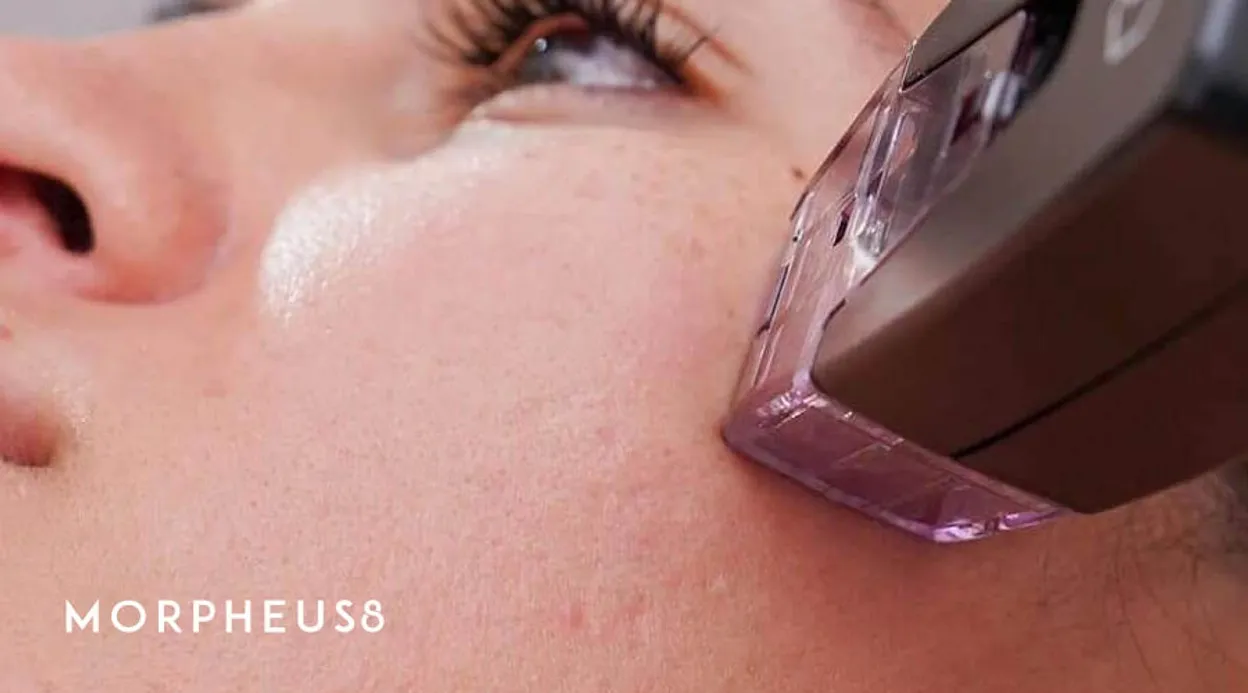
Why the deep passes feel different
This is the part that explains the contradictory accounts.
Depth and energy move together. The independent systematic review of radiofrequency microneedling records a practitioner rule of thumb:
| Needle depth | Rough energy level |
|---|---|
| 1 mm | 10 |
| 2 mm | 20 |
| 3 mm | 30 |
| 4 mm | 40 |
The same review reports something more directly relevant to how a session feels. Pulse durations at shallow settings run around 300 to 500 milliseconds. At deeper settings they rise to 2,800 to 4,000 milliseconds.
That is close to a tenfold difference in how long each pulse lasts. A shallow pass is a rapid sequence of brief events. A deep pass holds heat in the tissue for seconds at a time, where topical anaesthetic applied to the surface has less influence. The sharp, quick sensation some people describe and the deep, spreading ache others describe are two different settings, not a disagreement about the same one.
It also means the areas most often treated for jawline definition are treated deepest. If the jowl and neck are your reason for considering this, assume the deeper end.
The one published figure on pain
There is exactly one hard number, and it comes from an unexpected place.
A retrospective study of 25 patients used fractional radiofrequency microneedling to treat hidradenitis suppurativa, a chronic inflammatory skin condition. That is an off-label medical indication rather than cosmetic treatment. But it recorded what most cosmetic series do not: pain caused 3 of the 25 patients, 12 percent, to discontinue treatment.
Roughly one in eight stopped because of how it felt.
Two caveats. The patients were being treated for painful, inflamed lesions in areas including the groin, which is not comparable to a face under topical anaesthetic, and the senior author declares an occasional advisory relationship with the manufacturer plus a small shareholding. So this is not a pain rate for cosmetic Morpheus8 and should never be presented as one.
What it is, and this is the only reason to raise it, is documented evidence that the sensation this device produces is enough to end a course of treatment for a meaningful proportion of people who experience it. That is more useful to know than a marketing adjective.
What the internet says, and what that is worth
Consumer awareness of Morpheus8 rose sharply after Kim Kardashian posted about it, describing it as “painful lol but worth it”. In December 2023, Business Insider reported on patients describing painful experiences with the treatment.
Both belong labelled. This is market history and consumer reporting, not clinical evidence. A celebrity impression is not a pain study, and a journalist’s interviews are not a case series. Their real significance is that whether this hurts became a mainstream question, and that most pages answering it have been evasive ever since.
What you can reasonably ask for
Here the manufacturer’s own documentation is more useful than any clinic page, because it gives you specific things to request.
The operator manual states that the equipment is for use only by qualified medical professionals trained in the particular technique, that radiofrequency energy can cause injury if used improperly, and that the higher the energy applied, the greater the possibility of unintended thermal damage. Operators are told to use the lowest output setting necessary, to perform a test spot in a non-conspicuous area before the first full session, and to treat every tip as single use, because reuse risks cross-contamination and infection.
The independent review adds the finding that matters most: the highest conferred risk of complications was user error. Not the machine, and not the patient.
So four questions are entirely fair.
- What depth and energy will you use on each area, and why? You now know roughly what those numbers look like.
- Can we do a test spot first? It is in the manufacturer’s instructions. A practitioner who finds the request odd has told you how closely they read them.
- Will a fresh tip be opened for me? Single use only is the manufacturer’s own wording.
- What is the plan if I need you to stop? Worth agreeing before you are lying down and numb.
Take your full history seriously beforehand too. The list of people who should not have this treatment is longer and less obvious than most consultations suggest: who should not have Morpheus8 sets it out properly.

What you are actually consenting to
The reason the numbing protocol is this involved is worth stating plainly.
Morpheus8 is 510(k) cleared, not FDA approved. Clearance is a substantial equivalence pathway showing a device is close enough to one already on the market, and it is not a finding that the device works. No Morpheus8 clearance names wrinkles, skin tightening, acne scars, cellulite, stretch marks or fat reduction. The cleared wording covers electrocoagulation, haemostasis, and coagulation or contraction of soft tissue. Coagulation is the operative word: the discomfort is not incidental to the treatment, it is the sensation of controlled thermal injury being delivered at a chosen depth.
In October 2025 the FDA published a safety communication on radiofrequency microneedling reporting burns, scarring, fat loss, disfigurement, nerve damage and the need for surgical repair, and stated that radiofrequency microneedling “is a medical procedure, not a cosmetic treatment”. And no sham-controlled randomised trial of Morpheus8 exists: the one systematic review that excluded industry-funded studies rates the evidence base Level of Evidence 5, the lowest tier.
An hour of anaesthetic gel before a treatment is not a spa detail. It is the clearest signal available of what kind of procedure this is.
Afterwards the sensation changes rather than stops. Read what the recovery actually involves before you book, because the manufacturer’s own timeline is longer than the one clinics quote. And this is a course rather than a single appointment, so whatever you decide about the sensation, you are deciding it more than once.
None of this is an argument against having the treatment. It is an argument against being told it is nothing. If you are considering Morpheus8, book a consultation with us: we will tell you the depth and energy we would use on each area, what that is likely to feel like, and whether this is the right tool for what is bothering you.
At a glance
The pain question, weighed honestly
+ Reasons in favour
- The numbing is substantial and standard. The published facial protocol uses a topical 23 percent lidocaine with 7 percent tetracaine gel, left on the skin for 1 to 2 hours before anything begins
- Shallow facial settings deliver each pulse in roughly 300 to 500 milliseconds, so the sensation at 1 to 2 mm is brief and repeated rather than sustained
- The settings are negotiable. The manufacturer's manual tells operators to use the lowest output setting necessary and to perform a test spot before a first full session, so both are reasonable things to ask for
− Reasons for caution
- Pain is documented as a reason people stop. In a 25-patient study of an off-label medical use, it caused 3 of them, 12 percent, to discontinue treatment altogether
- A deep pass is a different experience from a shallow one. Pulse durations rise from roughly 300 to 500 milliseconds at shallow settings to 2,800 to 4,000 at deeper ones, and no one can tell you in advance how you will find that
- The published literature does not give a pain score for Morpheus8, so any number you are quoted, comfortable or brutal, comes from marketing or from a stranger's anecdote rather than from a study
Frequently asked questions
The short version.
01Does Morpheus8 hurt?
For some people it does, and the honest answer is that it varies more than clinics tend to admit. A 1 mm pass across the cheeks under topical anaesthetic and a 4 mm pass along the jawline are different experiences, because both the energy and the length of each pulse rise with depth. The clearest evidence that the sensation is real comes from a study of 25 patients treated for an off-label medical condition, where pain caused 3 of them, 12 percent, to stop treatment altogether. Discomfort or pain also appears in the manufacturer's own list of possible adverse events.
02What anaesthetic is used, and how long does it take to work?
The published facial protocol uses a topical gel of 23 percent lidocaine with 7 percent tetracaine, applied 1 to 2 hours before treatment. That waiting time is part of the appointment, so budget for it. In a retrospective cohort of 247 patients, 97.2 percent of procedures were performed under local anaesthesia, though those patients were having Morpheus8 combined with a separate radiofrequency procedure, so that figure is not a clean read for Morpheus8 on its own.
03How long does a Morpheus8 session take?
The treatment itself is shorter than the appointment. The published facial protocol recommends at least 500 pulses across the face, rising to 1,000 for severe cases, which takes time to deliver methodically. Mean procedure time in the largest published cohort was 58 minutes, but again those were combination procedures rather than Morpheus8 alone. Add 1 to 2 hours of numbing on top, plus a consultation if it is your first visit.
04Why does the jawline hurt more than the cheeks?
Because it is treated deeper. Zone-specific depths reported in the literature put the jowl at 4 mm and the submental area under the chin at 3 to 4 mm, where facial treatment more generally runs at 1 to 2 mm. Deeper settings pair with higher energy, and the independent review reports pulse durations rising from roughly 300 to 500 milliseconds at shallow settings to 2,800 to 4,000 milliseconds at deeper ones. A longer pulse means heat is held in the tissue for longer, and that is what changes the sensation.
05Can I ask for lower settings or a test spot?
Yes, and neither is an awkward request. The manufacturer's operator manual instructs practitioners to use the lowest output setting necessary and to perform a test spot in a non-conspicuous area before the first full session. Asking for both is asking for the device to be used the way its maker specifies. It is also fair to ask that a fresh tip is opened in front of you, because tips are single use only.