
Book a Morpheus8 session for your jawline and a Morpheus8 session for your abdomen, and the same console will be used for both. The physics does not change. Almost everything else does: a different applicator, a different tip with a different pin count, a different depth range, a different layer of tissue being heated, and an evidence base that is not merely thinner but points somewhere the marketing does not follow. One of those differences runs directly opposite to the way body treatment is usually sold.
The two treatments, side by side
| Face | Body | |
|---|---|---|
| Applicator and tip | Morpheus8 applicator: 24-pin standard tip, or the 12-pin Prime for small areas | Morpheus8 Body applicator: 40-pin tip |
| Depth range in the manufacturer’s manual | 1 to 7 mm standard, 1 to 4 mm on Prime | 2 to 7 mm |
| Depth in published clinical practice | 1 to 2 mm | 3 to 4 mm |
| What that depth reaches | dermis | dermis, and the subcutaneous fat beneath it |
| Largest published dataset | 247 patients | 20 patients |
| Treated with something else at the same time | FaceTite or BodyTite | nanofat grafting |
| Declared industry funding | InMode co-funded supplement, all authors InMode consultants | none declared |
| FDA cleared indication | coagulation or contraction of soft tissue, or haemostasis | the same wording, under the same clearance |
The last row is the one to read first. There is no separate body clearance and no separate cleared body indication: one set of words covers the applicator on your cheek and the applicator on your abdomen, and it names neither.
The hardware is genuinely different
Morpheus8 is one platform with a family of tips, and the tip is where the two treatments part company. The mechanism underneath is identical either way: insulated needle electrodes are driven to a set depth, and bipolar radiofrequency discharges from the exposed final 0.5 mm at the tip.
The standard facial tip carries 24 pins and offers depths of 1 to 7 mm in 1 mm steps, described in the manufacturer’s manual as being for dermal and subdermal treatment. The 12-pin Prime tip runs from 1 to 4 mm and exists for small areas that are difficult to manoeuvre around. The Resurfacing tip, also called the T tip, is the outlier and is not doing the same job at all: 24 blunt, uncoated pins, fixed at 0.5 mm with depth control disabled, treating the surface rather than anything below it.
The Body tip carries 40 pins and runs from 2 to 7 mm, described in the manual as being for dermal and subdermal treatment of large body areas.
Two details there do most of the work. Forty pins rather than 24 means more coverage per pass, which is what makes an abdomen or a pair of thighs practical to treat at all. And the shallowest setting on the Body tip is 2 mm, not 1 mm: the floor of the body range starts at the ceiling of ordinary facial practice.

The settings differ, and the manual says why
Depth is the entire technical argument for this device, and it is where the two sessions genuinely separate.
In published clinical practice, facial treatment runs at 1 to 2 mm and body treatment at 3 to 4 mm. Add roughly 1 mm to either figure for the thermal effect, which extends beyond where the needle physically stops.
There is a discrepancy in the paperwork that clinics rarely mention. The manual offers up to 7 mm. The FDA clearance summary for the original Morpheus8 clearance states a maximum treatment depth of 4.0 mm. Both are genuine, and routine body practice sits at the boundary between them.
The manual then supplies the most useful sentence in the subject.
Depth settings above 4 mm, the manufacturer’s own manual states, are used for treatment areas where subcutaneous fat is 1 cm thick or more.
That is the clearest statement anywhere of what the deep settings are for. Not skin. Fat. Keep hold of it, because the rest of this article turns on it.
The evidence does not transfer from one to the other
Facial evidence for this device is not strong, but it exists in volume. Its flagship is a retrospective series of 247 patients treated for jowling and neck laxity, and its central problem is that those patients received FaceTite or BodyTite at the same time, so it cannot isolate what Morpheus8 did on its own. The journal supplement was co-funded by InMode and all of its authors were InMode consultants.
The body evidence base is thinner than that.
There is exactly one body dataset with no declared financial interest, and it deserves reporting properly. A retrospective series in Colombia treated 20 patients, 19 women and one man, aged 20 to 45, with low-energy Morpheus8 combined with nanofat grafting, a fat grafting technique performed in the same session. Passes were graded by depth, from energy 18 to 20 at 5 to 6 mm down to 5 at 2 mm. On the Global Aesthetic Improvement Scale, scores moved from 3.35 to 1.76 and then to 1.52 by three months, at p less than 0.001. Some 85 percent of patients were rated very much improved, and no complications were recorded.
That is a real result, and the absence of an InMode relationship makes it unusual in this literature.
It also cannot be read as evidence for Morpheus8 alone, because every patient in it had fat grafted at the same time. Two interventions, one outcome measure, twenty patients, no control group. The confound is not a technicality: grafting fat into an area changes its contour by itself, which is what the scale was scoring.
The remaining body claims have less again. The only Morpheus8 cellulite publication is a case series with no retrievable sample size or outcome data, and it is Profound, a different device, that holds an actual FDA cellulite indication. For stretch marks, no Morpheus8-specific evidence exists.
Across both face and body, no sham-controlled randomised trial of Morpheus8 exists.
What the clearance covers, which is the same for both
Morpheus8 is 510(k) cleared, not FDA approved. Clearance is a substantial equivalence pathway in which a manufacturer shows a device is broadly like one already on the market. It is not a finding that the device works.
No Morpheus8 clearance names wrinkles, skin tightening, acne scars, cellulite, stretch marks, body contouring or fat reduction. The cleared wording covers dermatologic procedures where coagulation or contraction of soft tissue, or haemostasis, is needed, and it is the same wording for the body applicator as for the facial one.
That gap matters more on the body than on the face, because body marketing leans harder on the missing words. Subdermal adipose remodelling, the phrase attached to Morpheus8 Body, is InMode’s own marketing category rather than an FDA device classification. Fat melting is in no clearance either, and none of those phrases appear anywhere else on this site.
On 15 October 2025 the FDA published a safety communication on radiofrequency microneedling, reporting burns, scarring, fat loss, disfigurement, nerve damage and the need for surgical repair, and stating that radiofrequency microneedling is a medical procedure, not a cosmetic treatment.
The risk runs the opposite way to the marketing
Now put those two halves together, because they meet at the same tissue.
The most important independent paper in this field is a 2025 retrospective review of 180 face and neck lifts, by surgeons declaring no industry funding and no conflicts of interest. Of those patients, 123, or 68 percent, had had a prior neck intervention. Operating on them, the authors found a layer of fibrosis between the skin and the superficial cervical fascia, and named Morpheus8 specifically among the deeper-penetrating devices, describing irregularities related to greater subcutaneous fat loss in areas felt to correspond to where the needles had gone in.
Loss of that fat made achieving a smooth cervical contour, in their words, exceptionally difficult if not impossible. The risk of submental skin loss rose, a deep neck lift was required in 91 percent of cases, and contour irregularities were seen in nearly 100 percent.
So the treatment is sold on reaching subcutaneous fat, and the documented complication is losing subcutaneous fat. Those are the same sentence read from two directions. The deeper the setting, the closer the heat sits to the tissue whose loss the FDA lists among reported harms, which is not how deeper is usually presented.
One qualification belongs here. That surgical review examined necks, treated at facial depths. No equivalent independent audit of body-treated tissue has been published, so the deeper settings carry less independent scrutiny rather than more. Nobody has measured how much fat is lost, at what depth, or in how many patients.
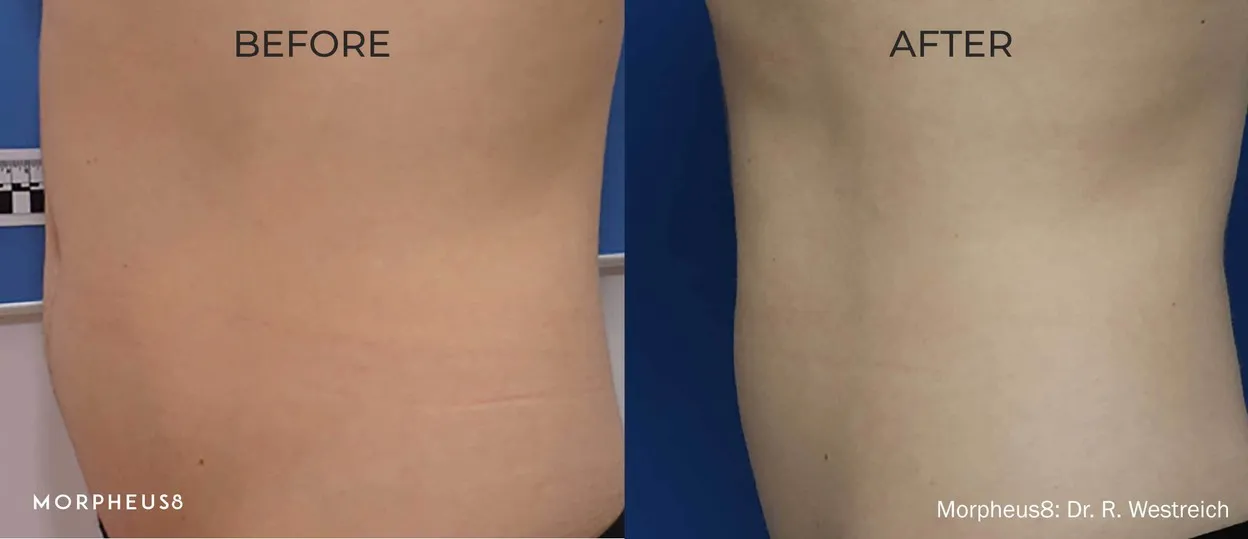
The manufacturer image below is marketing material, not a scored outcome, and not from our clinic. No single pair of photographs tells you what an individual should expect.
What to ask before booking a body session
If what has changed about your abdomen is a swelling, a lump, a hernia or a change in the skin rather than loose tissue, see a GP first, before anyone discusses treatment with you.
If it is laxity, the useful questions are mechanical. Which tip, at what depth, on which area, and why that depth for the thickness of tissue there. Whether the practitioner intends to go above 4 mm, and what that setting is for. What energy level, and how it has been adjusted for your skin type. And what happens if you decide on surgery in ten years.
None of this means the body version does nothing. It means the honest description is narrower than the advertised one, the evidence behind it is one confounded series of twenty patients, and the tissue it aims at is the tissue the regulator is worried about. Book a consultation with us and you will get those answers in millimetres rather than adjectives, including, where it applies, that this is not the right treatment for what is bothering you.
At a glance
Two treatments sold as one, weighed honestly
+ Reasons in favour
- The hardware difference is real and specific: the standard tip carries 24 pins at 1 to 7 mm, the Body tip carries 40 pins at 2 to 7 mm, and the 12-pin Prime tip covers small awkward areas at 1 to 4 mm
- The manufacturer's manual is unusually clear about what the deep settings are for, stating that depths above 4 mm are used where subcutaneous fat is 1 cm thick or more, which lets you ask a practitioner exactly what depth they intend and why
- The one body dataset without a declared financial interest is encouraging within its limits: 20 patients, Global Aesthetic Improvement Scale scores moving from 3.35 to 1.76 and then 1.52 by three months at p less than 0.001, 85 percent rated very much improved, and no complications
− Reasons for caution
- That 20-patient series treated everyone with nanofat grafting at the same time, so it cannot say what Morpheus8 contributed alone. It is the best independent body evidence available and it still cannot answer the question
- No Morpheus8 clearance mentions fat reduction or body contouring, and subdermal adipose remodelling is InMode's own marketing category rather than an FDA classification
- Independent surgical literature documents subcutaneous fat loss as an unwanted complication and the FDA lists fat loss among reported harms, so the deeper body settings sit closer to that tissue, not further from it
Frequently asked questions
The short version.
01Is Morpheus8 Body a different machine?
No. It is the same platform with a different applicator and a different tip. The FDA clearance covering the current range lists the Morpheus8 applicator with its 12-pin, 24-pin and T tip heads, and the Morpheus8 Body applicator with the 40-pin head, under one clearance and one set of cleared words. The Body tip carries 40 pins and runs from 2 to 7 mm, against 1 to 7 mm on the standard tip, so it covers more area per pass and cannot be set as shallow.
02Does Morpheus8 Body reduce fat?
That is not a claim we make, and the paperwork does not support it. No Morpheus8 clearance mentions fat reduction or body contouring anywhere in its indications. Subdermal adipose remodelling, the phrase attached to Morpheus8 Body in marketing, is InMode's own category rather than an FDA device classification. Meanwhile independent surgical literature documents subcutaneous fat loss as an unwanted complication of deep radiofrequency microneedling, and the FDA's October 2025 safety communication lists fat loss among reported harms. The same effect is being sold as a benefit in one place and reported as damage in another.
03How deep does a body treatment go compared with a face treatment?
In published clinical practice, facial treatment runs at 1 to 2 mm and body treatment at 3 to 4 mm, with roughly 1 mm of additional thermal effect beyond where the needle stops. The manufacturer's manual offers up to 7 mm on both the standard and Body tips, while the FDA clearance summary for the original Morpheus8 clearance states a maximum treatment depth of 4.0 mm. The manual adds that settings above 4 mm are used for treatment areas where subcutaneous fat is 1 cm thick or more.
04Is there published evidence that it works on the body?
Very little, and none of it isolates the device. The one body dataset whose authors declare no financial interest is a retrospective series of 20 patients in Colombia treated with low-energy Morpheus8 combined with nanofat grafting, so it cannot separate the two interventions. The only Morpheus8 cellulite publication is a case series with no retrievable sample size or outcome data, and it is Profound, a different device, that holds an actual FDA cellulite indication. For stretch marks there is no Morpheus8-specific evidence. No sham-controlled randomised trial of Morpheus8 exists for any area.
05What about Morpheus8 Burst and Burst Deep?
Burst is the current generation, described by InMode as deploying radiofrequency to multiple depths and energy levels within a single pulse, with a 12-pin Burst Prime, a 24-pin Burst, a 24-pin Burst Resurfacing and a 40-pin Burst Deep as the body tip. InMode publishes no numeric depths for the Burst range, and no peer-reviewed clinical study specific to Burst has been published. If a clinic quotes you Burst Deep depth figures, it is fair to ask which document they came from.