
Ask three clinics how long it takes to recover from Morpheus8 and you will almost certainly hear the same figure: two to five days. Read the manufacturer’s own manual for the machine and you get a different one: one to three weeks. Both numbers are published, both are real, and neither is a marketing invention. They are describing different things. The gap between them is where weddings, holidays and return-to-work dates go wrong, so this article sets out both figures, explains where each came from, and builds the timeline that is actually safe to plan against.
The two numbers, side by side
| Source | What it records |
|---|---|
| Peer-reviewed protocol, 247-patient cohort | Downtime of 2 to 5 days |
| Manufacturer’s operator manual | Redness lasting not longer than 24 hours, described as typical |
| Manufacturer’s operator manual | Swelling for 1 to 3 weeks |
| Manufacturer’s operator manual | Crusting from the treated dots exfoliating naturally after 1 to 3 weeks |
| Independent systematic review | Visible grid marks persisting 1 to 2 weeks |
The 2 to 5 days is a clinical figure, and a genuine one. It comes from the largest published Morpheus8 dataset, a retrospective series of 247 patients, and it describes downtime in the sense a surgical paper means it: how long before patients were back to their ordinary activity.
Three things belong immediately beside it. Morpheus8 in that series was combined with a separate radiofrequency device rather than used alone. The supplement it appeared in was funded by the manufacturer, and the authors were manufacturer consultants. And it is a measure of function, not of skin. Being back at your desk on day four is not the same thing as your face having finished changing.
The 1 to 3 weeks is the manufacturer’s own account of how long the tissue takes to resolve, written for the practitioners who operate the device rather than for the people paying for it. It is the less flattering figure and it appears in the less public document, which is a good reason to weight it rather than discount it.
What actually happens, day by day
The first 24 hours
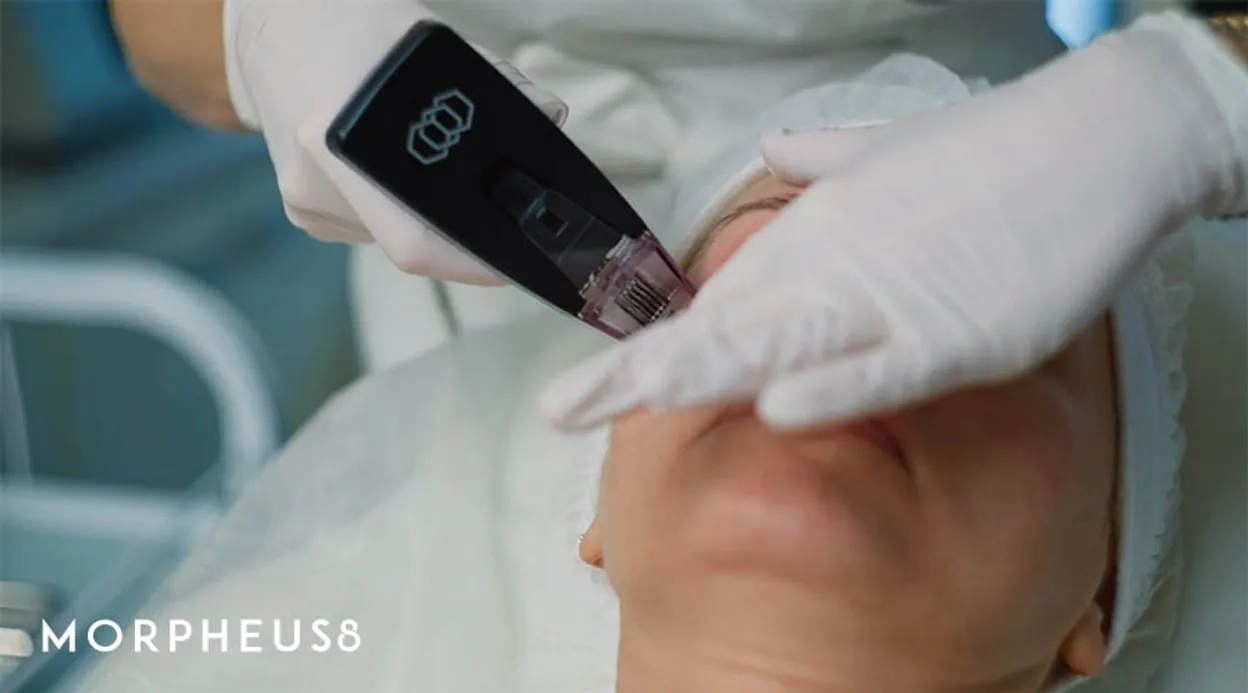
You come out red. The manual describes erythema lasting not longer than 24 hours as typical, and minor pin-point bleeding as something that may occur, which is what an array of needle electrodes into skin produces. Swelling starts during this window rather than after it, and often looks worse on waking the next morning than it did at the clinic.
The first week
Redness fades and swelling takes over as the main event. The dots left where the needle tips discharged their energy form fine crusts, and a faint pattern becomes visible across the treated area: the grid, the shape of the needle array printed onto your skin. The independent review literature reports those grid marks persisting for 1 to 2 weeks.
Somewhere in this week is the point the published protocol calls the end of downtime. It is a reasonable description of function and a poor description of appearance. Most people are working and living normally well before the skin looks untreated.
Weeks two and three
This is the part almost nobody is warned about. The manual expects swelling to run for up to three weeks, and expects the crusts to exfoliate naturally over the same window. Naturally is the operative word: they come off in their own time, and picking them off is how a controlled thermal injury becomes a scar.
Grid marks are usually gone by the end of week two. Swelling can be subtle by then, more a sense that your face is not quite your face than anything anyone else would name, and it can still be asymmetric.
The tail, and how long it can run
Beyond three weeks, the timeline stops being typical and becomes a matter of rates. The same 247-patient series counted them.
| What happened | How often |
|---|---|
| Swelling still present beyond 6 weeks | 4.8 percent, 12 of 247 |
| Hardened areas still present beyond 12 weeks | 3.2 percent, 8 of 247 |
Neither is common. Neither is nothing. A hardened area still present three months after a treatment sold as a lunchtime procedure is a substantial thing to be living with. The rate is worth quoting so that if it happens to you, it reads as a recognised outcome rather than something you have imagined. The wider list of side effects and their published rates sits alongside these.
The aftercare that is written down
Most Morpheus8 aftercare advice you will be handed is a clinic’s own protocol. Some of it is sensible and none of it has been tested against a control. Two instructions are different, because they come from the manufacturer’s own documentation.
Sun protection, for longer than you think
Use SPF 30 or higher, and protect the treated area from over-exposure to sunlight for at least one month after treatment. Excessive tanning of any kind is prohibited for the entire treatment course.
Read that second sentence again, because it is almost never mentioned at the point of booking. It is not one month, once. It applies across the whole course. A common protocol is 3 sessions spaced 3 to 6 weeks apart, which puts six to twelve weeks between the first session and the last, and then the sun protection window runs for a month past the final one.
Start a course in May and the restriction is still live in August. Sunbeds and self-tanning products are included, not just daylight, and the rule runs in both directions: the manufacturer lists skin that has been excessively tanned or irritated within the previous two weeks as a reason not to treat at all. A treatment plan and a summer holiday plan can quietly cancel each other out, and it is far better to discover that before the deposit than after.

Pigmentation, and the regime that is prescribed rather than bought
The second written instruction applies to some people and not others. For Asian patients and for Fitzpatrick skin types IV to V, the manufacturer’s instructions say a physician may prescribe a bleaching regime to reduce the risk of post-inflammatory hyperpigmentation: 6 to 12 weeks in duration, 2 to 3 times weekly, started after healing, which is given as typically 7 days, and stopped 48 to 72 hours before the next session.
That is unusually specific for aftercare, and worth knowing about for one reason above all. It is prescribed, not purchased. It is a physician decision, it is timed around your session schedule, and it is not something to assemble yourself from an online skincare order. Post-inflammatory hyperpigmentation is named among the key risks in the independent review literature, and if your skin tone puts you in this group, the question to ask at consultation is what the plan for it is, before the first session rather than after a mark appears.
One further point sits in the same territory. A history of recurrent cold sores in the treatment area is not a reason to be turned away, but it is a reason to be treated only under a prophylactic regime, which again means a prescription arranged in advance.
What none of this has been measured against
Everything above comes from two kinds of document: a manufacturer’s instructions to operators, and retrospective case series. Neither is a trial.
No sham-controlled randomised trial of Morpheus8 has been published. The one systematic review that excluded industry-funded studies, applied a formal risk-of-bias tool and declared no funding and no conflicts of interest rates the evidence base for radiofrequency microneedling Level of Evidence 5, the lowest tier there is. So the recovery timeline in this article is the best-documented one available, and it is still assembled from sources with obvious limitations rather than measured against a comparison group.
The regulatory position is worth stating in the same breath, because it changes how you should read the whole procedure. Morpheus8 is 510(k) cleared, not FDA approved. Clearance is a substantial-equivalence pathway: it shows a device is close enough to one already on the market, and is not a finding that it works. No Morpheus8 clearance names wrinkles, skin tightening, acne scars, cellulite, stretch marks, body contouring or fat reduction. The cleared wording covers electrocoagulation, haemostasis, and coagulation or contraction of soft tissue.
And on 15 October 2025 the FDA published a safety communication on radiofrequency microneedling reporting burns, scarring, fat loss, disfigurement, nerve damage and the need for surgical repair, and stating plainly that radiofrequency microneedling is a medical procedure, not a cosmetic treatment.
A recovery period is what a medical procedure has. Planning around it properly is not being precious, it is treating the thing as what the regulator says it is.
Planning around it
Work backwards from the date that matters. If there is an event, count three weeks from your last session to it rather than five days, and if the date is immovable, count more. How many sessions you are likely to need, and how they are spaced determines the shape of the whole course, and the course is what the sun rules attach to, so it is worth mapping the entire thing onto a calendar before you commit to the first appointment.
Then ask three questions at consultation. What depth and energy on which area, since the recovery follows from both. What the plan is for pigmentation if your skin type calls for one. And what happens, specifically, if something has not settled at six weeks: who you call, whether you are seen, and whether you are charged.
If you are still at the stage of wondering what the session itself involves, that is the sensible order to take these in. Book a consultation with us and we will give you the honest version of both: what the appointment is like, and what the following three weeks are like, with the longer numbers rather than the flattering ones.
At a glance
The recovery, weighed honestly
+ Reasons in favour
- The most visible part really is brief. The manufacturer's operator manual describes redness lasting not longer than 24 hours as typical, and minor pin-point bleeding as the worst of what happens on the day
- The aftercare that matters most is specific and cheap: SPF 30 or higher, protection from over-exposure to sunlight for at least one month after treatment, and no excessive tanning for the whole course
- The long tail is uncommon and has been counted. In a series of 247 patients, swelling persisted beyond 6 weeks in 4.8 percent and hardened areas beyond 12 weeks in 3.2 percent
− Reasons for caution
- The 2 to 5 day figure clinics quote is the shortest one in the literature. The manufacturer's own manual expects swelling and crusting to take 1 to 3 weeks, and the independent review reports visible grid marks for 1 to 2 weeks
- The sun rules apply across the entire course, not just the week after a session, so a plan of 3 sessions spaced 3 to 6 weeks apart can rule out a summer holiday for months
- None of the recovery advice has been tested against a control. No sham-controlled randomised trial of Morpheus8 exists, and the downtime numbers come from retrospective series that were sponsor funded
Frequently asked questions
The short version.
01How long is Morpheus8 downtime, honestly?
Two answers exist and both are published. The peer-reviewed protocol from a 247-patient cohort records 2 to 5 days of downtime, and that is the figure clinics quote. The manufacturer's operator manual describes redness lasting not longer than 24 hours as typical, but swelling persisting for 1 to 3 weeks and crusting from the treated dots exfoliating naturally over the same 1 to 3 weeks. The independent review literature adds visible grid marks at 1 to 2 weeks. If you are planning around a fixed date, plan against the longer figures, because nothing in the published record promises the shorter ones.
02Why do clinics say 2 to 5 days when the manufacturer says 1 to 3 weeks?
Because they are describing different things and quoting different documents. The 2 to 5 days comes from a published clinical protocol and reflects the point at which patients were back to normal activity. The 1 to 3 weeks comes from the manufacturer's instructions to operators, and describes how long the tissue changes themselves take to resolve. Neither figure is invented. The problem is that only the shorter one tends to appear on clinic pages, which leaves people surprised in week two when the swelling has not finished.
03Can I go back to work the next day?
Possibly, depending on your job and your tolerance for being seen with visible redness and a faint dot pattern on your skin. Redness is described as typically resolving within 24 hours, but swelling and crusting run considerably longer, and grid marks are reported at 1 to 2 weeks. No published figure exists for when makeup can go back on, so treat any specific day count you are given as your practitioner's own protocol rather than an evidence-based one, and ask what it is based on.
04Do I really have to avoid the sun afterwards?
Yes, and for longer than most people expect. The manufacturer's instructions require SPF 30 or higher and protection of the treated area from over-exposure to sunlight for at least one month after treatment, and prohibit excessive tanning of any kind for the entire treatment course. Since a course commonly runs to 3 sessions spaced 3 to 6 weeks apart, the restriction covers the whole course plus a month past the last session. Sunbeds and tanning products count.
05What if the swelling has not settled after a month?
That is uncommon but documented, so it is worth having looked at rather than waited out. In the 247-patient series, swelling still present beyond 6 weeks occurred in 4.8 percent and hardened areas still present beyond 12 weeks in 3.2 percent. Go back to the practitioner who treated you first. If you are not satisfied with the answer, or if you have numbness, a burn, a blister or a hollow that is not filling back in, see your GP or ask for a dermatology referral rather than posting about it on a forum.