
If you have arrived here worried, the useful first move is to separate three questions that get asked as one. What happens to almost everyone, and settles. What happens to a small minority, and lasts longer than it should. And what happens rarely, but is serious enough that a regulator has written about it. Morpheus8 has documented answers to all three, and they are very different sizes. Clinic pages describe only the first, the frightening accounts you may have read only the third. Neither is invented, and neither alone is honest.
What almost everyone gets, and how long it really lasts
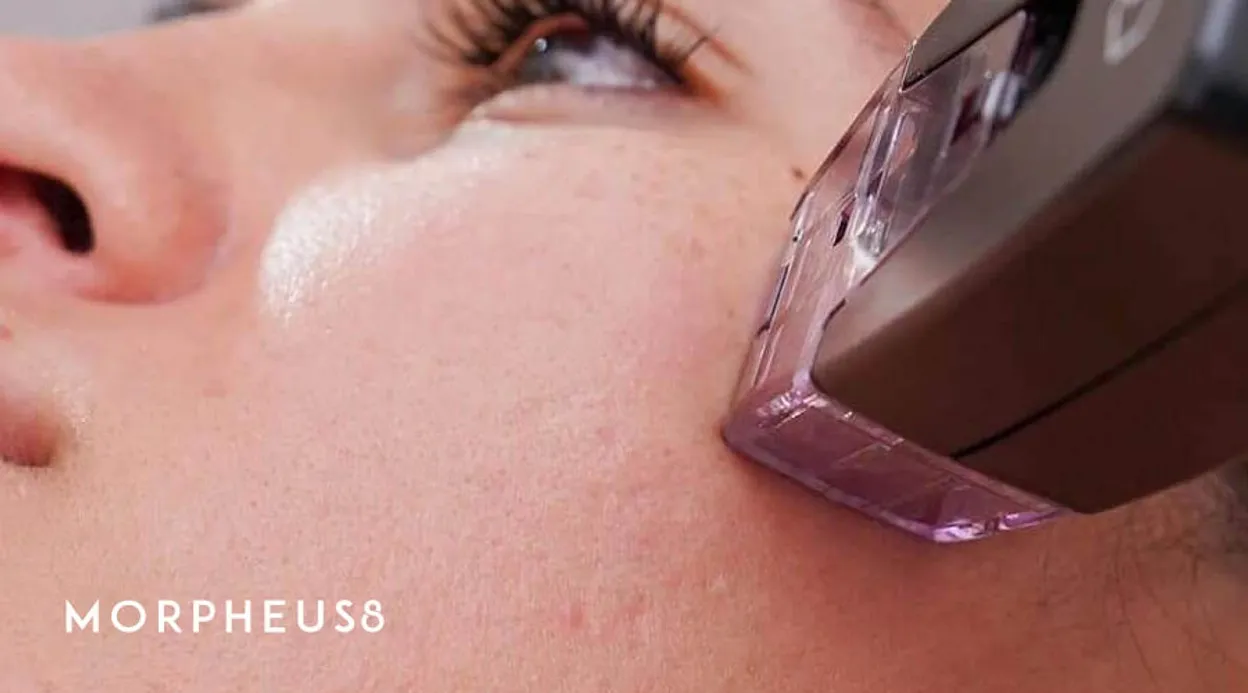
Morpheus8 injures skin twice on purpose: mechanically with needle electrodes, and thermally with radiofrequency discharged at a chosen depth. What follows is skin responding to both.
The manufacturer’s operator manual describes redness lasting no longer than 24 hours as typical, swelling that can persist for 1 to 3 weeks, and crusting from the treated dots that exfoliates naturally over the same 1 to 3 weeks. Minor pinpoint bleeding is also normal. The independent review literature adds visible grid marks, the faint pattern left by the needle array, persisting for 1 to 2 weeks.
That is a wider window than clinics quote. The largest Morpheus8 cohort records 2 to 5 days of downtime, and that is the figure marketing uses. Both are real: 2 to 5 days is when you look presentable, 1 to 3 weeks is when the manufacturer expects the skin to have finished. Plan around the longer one, and read what the recovery actually involves first.
The FDA’s general list for microneedling devices covers similar ground: dryness, tightness, itching, peeling, discomfort, burning, bruising and crusting. None of it is a complication. It is the treatment working as designed.
When it lasts longer than it should
The clearest complication figures for Morpheus8 come from a retrospective series of 247 patients treated for neck laxity and jowling.
| What happened | How often |
|---|---|
| Swelling still present beyond 6 weeks | 4.8 percent, 12 of 247 |
| Hardened areas still present beyond 12 weeks | 3.2 percent, 8 of 247 |
| Neuropraxia | 1.2 percent, 3 of 247 |
| Visible grid marks | 1 to 2 weeks |
Neuropraxia is a nerve conduction injury: the nerve is not severed, but it stops signalling properly, which presents as numbness, altered sensation or weakness in the area it serves. Three in 247 is a small number, but not zero, and worth knowing a procedure sold in the same breath as a facial can cause it.
Pain deserves its own line, because it is the effect most likely to change what you decide. In a separate study of 25 patients treated for an off-label medical condition, pain caused 3 of them, 12 percent, to stop treatment altogether. Different indication, small sample: read it not as a facial rate but as evidence the discomfort is enough to end courses.
Two caveats belong beside that table. The series was retrospective, the patients had Morpheus8 combined with a separate radiofrequency device rather than alone, the supplement was co-funded by InMode, and every author was an InMode consultant. And no sham-controlled randomised trial of Morpheus8 exists: the one systematic review that excluded industry-funded studies rates the evidence base Level of Evidence 5, the lowest tier. These are the best complication figures anyone has, not a measured baseline.
The manufacturer’s own list is blunter than the marketing
Read what InMode tells operators. The manual lists these possible adverse events: discomfort or pain, excessive redness, swelling, damage to the natural texture of the skin including crusting, blistering and burns, pigment change in either direction, and scarring. It then notes that the list is not exhaustive.
Burns and scarring, in other words, have been in the manufacturer’s own documentation from the start. Nothing the regulator said in 2025 was news to anyone who had read it.
What the FDA said on 15 October 2025
On 15 October 2025 the FDA published a safety communication about radiofrequency microneedling. It reported adverse events including burns, scarring, fat loss, disfigurement, nerve damage and the need for surgical repair. It stated that these devices should not be used at home, that its evaluation is ongoing and that it is working with manufacturers. And it made one statement worth reading twice: radiofrequency microneedling “is a medical procedure, not a cosmetic treatment”.
The communication covers the whole device class rather than Morpheus8 alone, and attaches no rate to any of the harms it lists. That limitation matters: a reported adverse event tells you something happened somewhere, not how often.
It also lands against a regulatory position most clinic pages get wrong. Morpheus8 is 510(k) cleared, not FDA approved: clearance shows a device is close enough to one already on the market, and is not a finding that it works. No Morpheus8 clearance names wrinkles, skin tightening, acne scars, cellulite, stretch marks or fat reduction. The cleared wording covers electrocoagulation, haemostasis, and coagulation or contraction of soft tissue. The procedure whose risks you are weighing has never been assessed by a regulator for the purpose it is sold for.
What the professional bodies said in reply
The next day, 16 October 2025, the American Academy of Dermatology published a statement from its president, Susan C. Taylor, MD: “while cosmetic treatments may appear simple, performing them safely requires an in-depth understanding of the structure and function of the skin”. Patients were advised to consult board-certified dermatologists.
On 8 December 2025 the American Society for Laser Medicine and Surgery and the American Society for Dermatologic Surgery issued a joint response. They maintained that radiofrequency microneedling in appropriate settings is safe and effective, but urged their members to add burns, scarring, fat loss, disfigurement and nerve damage to their consent forms, and to raise safety with manufacturers before buying a device.
Two surgical societies have told their own members that those five risks belong on a consent form. If the form you are handed does not name them, you know what a current one looks like.
The fat loss finding, and why it stands apart
Fat loss deserves separate treatment, because independent evidence for it existed before the FDA published anything.
A 2025 retrospective review examined 180 face and neck lifts performed in a single year, by authors declaring no funding and no conflicts of interest, which is unusual in a literature that is mostly sponsor linked. Of the 180 patients, 123, or 68 percent, had undergone some prior neck intervention, 37 of them non-surgical.
Operating on them, the surgeons found a layer of fibrosis between the skin and the superficial cervical fascia. They named Morpheus8 specifically among the deeper penetrating devices, describing irregularities related to greater subcutaneous fat loss in areas corresponding to needle penetration. The consequences were surgical: fat loss made a smooth neck contour “exceptionally difficult, if not impossible”, raised the risk of submental skin loss, and a deep neck lift was required in 91 percent of cases, with contour irregularities in nearly 100 percent.
It is easy to over-read that. These were people who went on to have surgery, a selected group, so the paper gives no denominator for how likely fat loss is. What it establishes is that the effect is real, that it tracks needle depth, and that it is hard to put right. It matters most for the areas this device is used on most, the jowls and the neck.
One further detail is quietly instructive. Five patients, 4 percent of the series, had not disclosed their prior non-surgical treatment. If you have had Morpheus8, particularly on the neck or jawline, it belongs in your medical history permanently. A surgeon who does not know is planning against tissue that no longer behaves the way it looks.
What actually reduces the risk
The independent systematic review names the highest single source of complication risk plainly, and it is not the machine. It is user error.
That is encouraging, because user error is controllable in a way that a device’s physics is not. The manual is unambiguous. The equipment “is for use only by qualified medical professionals trained in the particular technique to be performed”. Radiofrequency energy “can cause injury if used improperly”, and “the higher RF is applied, the greater the possibility of unintended thermal damage”. Operators are told to use the lowest output setting necessary, to perform a test spot in a non-conspicuous area before a first full session, and to treat every tip as single use.
That turns into four things you can reasonably ask for.
- A test spot. It is in the manufacturer’s instructions, not an awkward favour, and a practitioner who finds the request odd has told you how closely they read the manual.
- Who will hold the handpiece, and what they are trained in. No licensing scheme is in force in England, so who is allowed to perform Morpheus8 in the UK is a longer answer than people expect.
- What depth and energy, and how both are adjusted for your skin type. Depth is the technical argument for this device, and where the fat loss risk comes from.
- A full history taken properly. The contraindication list is long and not obvious from outside: implants, medication, pregnancy, skin conditions, recent treatments. Who should not have Morpheus8 sets it out.

If something is already wrong
If you have been treated and something is not settling, a blister, a burn, numbness, changed texture, or a hollow that is not filling back in, that is a clinical problem rather than a beauty one. Go back to the practitioner who treated you, and if you are not satisfied, see your GP or ask for a dermatology referral. Do not wait it out on a forum post.
If you are still deciding, none of this is an argument against the treatment. It is an argument for treating it as what the regulator says it is: a medical procedure. Book a consultation with us and we will take your history, tell you the depth and energy we would use and why, and show you a consent form that names the risks the surgical societies say it should.
At a glance
The safety picture, weighed honestly
+ Reasons in favour
- Most of what happens is expected and self limiting. The manufacturer's own manual puts redness at under 24 hours, with swelling and crusting resolving over 1 to 3 weeks
- The lasting complications recorded in the largest published series are uncommon: hardened areas beyond 12 weeks in 3.2 percent and neuropraxia in 1.2 percent of 247 patients
- Much of the risk is controllable rather than random. The independent review names user error as the single largest source of complications, and the manufacturer's manual requires a test spot before a first full session
− Reasons for caution
- The FDA's October 2025 safety communication reports burns, scarring, fat loss, disfigurement, nerve damage and the need for surgical repair, and attaches no rate to any of them
- The complication rates that do exist come from retrospective series, mostly sponsor funded, with no sham-controlled trial anywhere in the evidence base. They are the best figures available, not a measured baseline
- Subcutaneous fat loss is documented independently, and the surgical literature describes the resulting contour as exceptionally difficult to correct afterwards
Frequently asked questions
The short version.
01Is Morpheus8 safe?
That question has three answers, not one. The common effects are redness, swelling, crusting and grid marks, and they are expected rather than complications. Effects that outlast them are uncommon: in a series of 247 patients, swelling persisted beyond 6 weeks in 4.8 percent, hardened areas beyond 12 weeks in 3.2 percent, and neuropraxia occurred in 1.2 percent. Serious harm is rarer still, but it is documented: the FDA's October 2025 safety communication reports burns, scarring, fat loss, disfigurement, nerve damage and the need for surgical repair. No rate is published for those, which is a genuine gap rather than reassurance.
02What did the FDA report on 15 October 2025?
The FDA published a safety communication on radiofrequency microneedling as a device class, reporting burns, scarring, fat loss, disfigurement, nerve damage and the need for surgical repair. It said these devices should not be used at home, that its evaluation is ongoing, and that radiofrequency microneedling is a medical procedure, not a cosmetic treatment. Two surgical societies responded jointly on 8 December 2025, maintaining that the treatment is safe and effective in appropriate settings while urging their own members to add those specific risks to their consent forms.
03Can Morpheus8 cause fat loss in the face?
Fat loss is one of the harms named in the FDA's 2025 communication, and independent evidence for it predates that. A 2025 retrospective review of 180 face and neck lifts, by authors declaring no funding and no conflicts of interest, named Morpheus8 among deeper penetrating devices and described contour irregularities related to greater subcutaneous fat loss in areas corresponding to needle penetration. That series looked only at people who went on to have surgery, so it cannot tell you how often this happens across everyone treated. It does tell you the effect is real and hard to reverse.
04How long do the normal side effects last?
Longer than most clinics say. The published protocol from the largest cohort records 2 to 5 days of downtime, which is roughly when you look presentable. The manufacturer's operator manual describes redness lasting no longer than 24 hours as typical, but swelling persisting for 1 to 3 weeks and crusting from the treated dots exfoliating over the same 1 to 3 weeks. Visible grid marks from the needle array are reported at 1 to 2 weeks. If you are planning around an event, plan around the longer figures.
05Should I ask for a test spot?
Yes, and it is not an awkward request. The manufacturer's own operator manual instructs practitioners to perform a test spot in a non-conspicuous area before the first full session, and to use the lowest output setting necessary. Asking for one is asking for the device to be used as its maker intends. A practitioner who treats the request as unusual has told you something useful about how closely they read the manual.