
Ask five clinics which radiofrequency microneedling device is best and you will get five answers, each of them the machine that clinic already owns. No trial can settle it, because nobody has run one. What does exist is a stack of FDA 510(k) summaries, one per device, filed by the manufacturers themselves. Read side by side they answer a narrower question than “which is best”, but they answer it precisely: how deep each device reaches, where its heat lands, how that heat is controlled, and what each is permitted to say it treats. On the last of those, Morpheus8 comes off worse than two of its competitors.
The devices side by side
Every row below comes from the manufacturer’s own 510(k) summary, the primary regulatory document filed to reach the US market.
| Device | Maker | Clearance | Needles and depth | Insulation and RF | Cleared indication |
|---|---|---|---|---|---|
| Morpheus8 | InMode | K192695 (2019), updated by K231790 (2023) and K240017 (2024) | 12, 24 and 40 pin tips plus a T tip; 4.0 mm in the clearance summary, 1 to 7 mm in the manual | Insulated except the distal 0.5 mm; bipolar, 1 MHz, 65 W | Coagulation or contraction of soft tissue, or haemostasis |
| Genius RF | Lutronic | K180945 (2018) | 49 needles in a 7 by 7 array; 0.5 to 3.5 mm | Coagulates around the uninsulated portion of the needle | Electrocoagulation and haemostasis |
| Potenza | Jeisys Medical, sold by Cynosure | K192545 (2020) | Six motor tips and three AC tips; up to 4.0 mm | Monopolar and bipolar; 1 MHz or 2 MHz | Electrocoagulation and haemostasis |
| Profound | Syneron Candela | K161043 (2016) | Dermal handpiece, five electrode pairs; subcutaneous handpiece, seven channels | Real-time temperature sensors targeting 65 to 75 degrees Celsius | Electrocoagulation and haemostasis, plus facial wrinkles and the appearance of cellulite in Fitzpatrick I to III |
| Secret RF | ILOODA, sold by Cutera | K170325 (2017) | 0.5 to 3.5 mm in 0.1 mm steps; two handpieces | Bipolar | Electrocoagulation and haemostasis |
| Vivace | ShenB and Aesthetics Biomedical | K193070 (2021) | 36 needles in a 6 by 6 array; 0.5 to 3.5 mm | Bipolar; 1 MHz and 2 MHz | Electrocoagulation and haemostasis, plus facial wrinkles in Fitzpatrick I to V at 1 MHz |
Two devices you may be offered are absent for the same reason. EndyMed’s Intensif, cleared in 2014, publishes no needle count or depth in its public summary, and for VIOL’s Sylfirm X, cleared in 2022, no specification or indication wording was retrievable here. Guessing at either would be worse than the gap.
Depth is the genuine difference, and it is Morpheus8’s
On the specification clinics argue about most, Morpheus8 wins, and the margin is not small. Genius RF, Secret RF and Vivace all stop at 3.5 mm. Potenza reaches 4.0 mm. The Morpheus8 manual offers 1 to 7 mm on the 24 pin tip and 2 to 7 mm on the 40 pin body tip, plus roughly a further millimetre of thermal effect.
That gap decides which tissue the heat reaches. At 3.5 mm you are working in the dermis. Beyond about 4 mm you are heating subcutaneous fat, and the manual says so directly: settings above 4 mm are for areas where the fat layer is 1 cm thick or more. The insulated electrode that makes this possible is worth understanding first.
A complication sits inside the winning number. The FDA summary for the original clearance states a maximum treatment depth of 4.0 mm, while the manual offers 7 mm. Both are real, and clinics quoting 7 mm rarely mention the other. Depth is a capability rather than a result, and nothing published shows that reaching further produces a better outcome.
Where the insulation sits changes where the heat lands
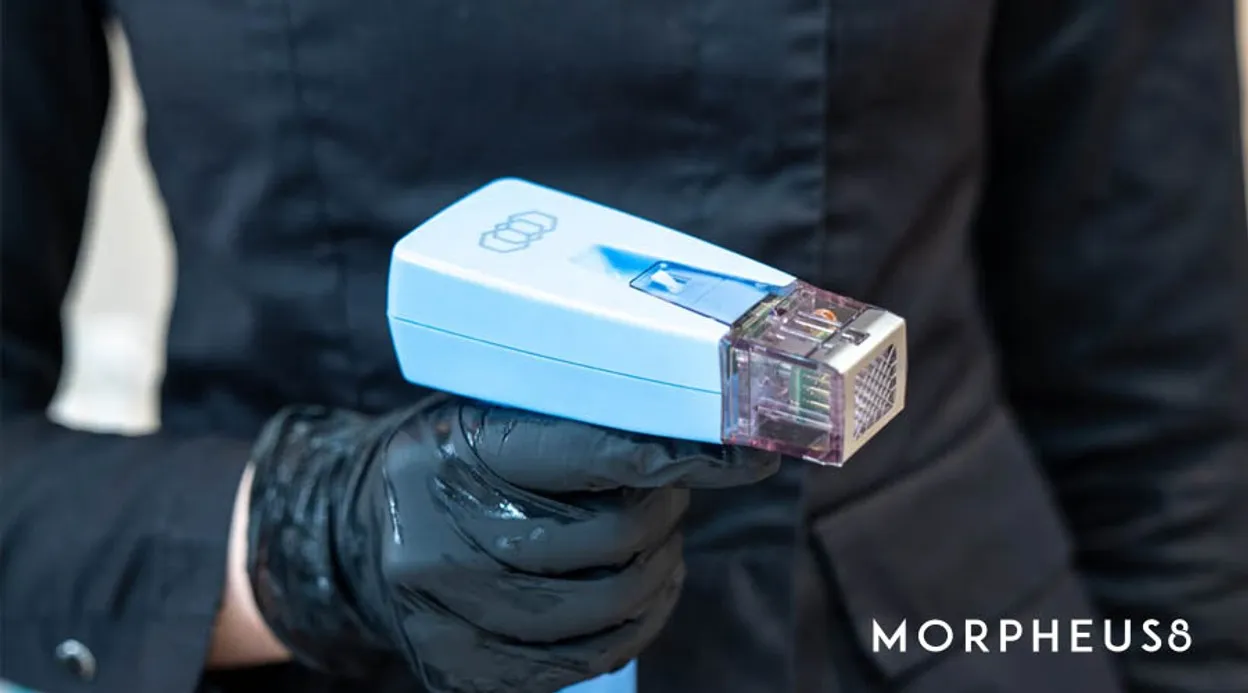
Morpheus8 needles are coated along their length except the final 0.5 mm at the tip. Current cannot escape into the tissue the needle passed through on the way down, so coagulation happens at the bottom of the tract, with the layers above largely spared.
Genius works the other way: its clearance summary describes it coagulating around the uninsulated portion of the needle, and the independent review literature describes Vivace as non-insulated. A bare needle heats the whole tract it occupies, including tissue near the surface.
Neither approach is simply better: treating the full tract is a different treatment rather than a worse one. But two devices set to the same number of millimetres are not doing the same thing, and the number tells you where the needle went, not where the heat stayed.
The clearance runs the other way round
None of these devices is FDA approved. All of them, Morpheus8 included, are 510(k) cleared, meaning the manufacturer demonstrated substantial equivalence to something already on the market, not that the device works. The distance between those two words is the most useful thing to carry into a consultation.
Within that shared pathway the wording differs sharply. Vivace holds a percutaneous facial wrinkle indication for Fitzpatrick skin types I to V at 1 MHz. Profound holds a facial wrinkle indication with its dermal handpiece, and an indication for improvement in the appearance of cellulite in Fitzpatrick I to III, supported by 6-month data. Morpheus8 holds neither. Its cleared wording covers dermatologic procedures where coagulation or contraction of soft tissue, or haemostasis, is needed, and no Morpheus8 clearance names wrinkles, skin tightening, acne scars, cellulite, stretch marks or fat reduction.
So the device marketed hardest for facial rejuvenation is, of the three, cleared for it least specifically. That is worth saying plainly rather than smugly: the marketing is everywhere, and believing it is reasonable.
InMode’s own claim needs handling precisely, in both directions. The company announced Morpheus8 as the first and only fractional radiofrequency device cleared for soft tissue contraction, and on that wording it is accurate: the contraction language appears in the Morpheus8 clearance and not in the others here. What it is not is a claim to being the most broadly cleared device, and read that way it points the opposite direction to the paperwork.
How the heat is controlled
These are heating tools, so how each one knows the temperature matters. Profound uses real-time temperature sensors, targeting 65 to 75 degrees Celsius, plus or minus 1 degree. It measures what is happening in the tissue and works to that number.
Morpheus8 has no equivalent closed loop. The literature describes it targeting roughly 50 degrees Celsius in soft tissue while the surface stays at 40 to 42 degrees, but that is the expected consequence of the depth, energy and pulse duration a practitioner selected, not a reading fed back from tissue. The two architectures put the responsibility in different places, which matters next to the finding from the only independent review of this modality: user error is the largest single source of complication risk.
Delivery mode differs too. Morpheus8 is bipolar at 1 MHz, with a maximum output of 65 W, so current passes between pairs of pins rather than through the body to a distant return pad. Potenza offers monopolar and bipolar delivery at either 1 MHz or 2 MHz, and Vivace offers 1 MHz and 2 MHz, though its 2 MHz mode was not evaluated for the wrinkle indication it holds. More modes means more flexibility for a practitioner who knows what to do with them.
Nobody has run the comparison
Morpheus8 has more published branded literature than most of its competitors, which sounds like an answer until you look at what it is: largely retrospective case series, much of it in manufacturer-sponsored journal supplements written by manufacturer consultants, and rated Level of Evidence 5, the weakest tier, by the one systematic review that excluded industry-funded studies. No sham-controlled randomised trial of Morpheus8 exists.
More to the point here, no head-to-head trial of Morpheus8 against another radiofrequency microneedling brand has been published. Not against Potenza, Profound, Vivace or Genius. Any claim that one of these devices outperforms another is unsupported, including when we would be the ones making it.
Every league table ranking these machines was assembled from marketing, because there is no trial to assemble one from.
The safety communication covers every device here
On 15 October 2025 the FDA published a communication on the potential risks of certain uses of radiofrequency microneedling, reporting burns, scarring, fat loss, disfigurement, nerve damage and the need for surgical repair, and stating that radiofrequency microneedling is a medical procedure, not a cosmetic treatment. Two professional societies later urged their members to add those risks to consent forms. The communication is class-wide: it covers the modality, which means every device in the table above, and reading it as a Morpheus8 problem misses the point.
One nuance runs the other way and belongs here for honesty. The single independent paper naming a device in relation to subcutaneous fat loss names Morpheus8: a review of 180 face and neck lifts, by authors declaring no industry funding and no conflicts of interest, describing contour irregularities related to greater fat loss where needles had penetrated. That is not evidence the others are safer, since none was examined the same way, but it is consistent with depth being the mechanism at issue, which puts the differentiator and the harm in the same column.

What actually decides the outcome
The brand is a smaller variable than the marketing implies, and the practitioner a larger one. Depth, energy, adjustment for skin type and the number of passes are operator decisions that sit above the badge on the machine in anything the evidence can distinguish. For some of what all these devices are sold for, the simpler mechanical treatment holds the better paperwork.
Useful questions are therefore mechanical rather than brand-led. What depth on which area, and why that number. What energy, and how it is adjusted for your skin type. Who will hold the handpiece, and what they trained on. Book a consultation with us and you will get those answers as numbers, alongside a straight view of whether a device of this kind is right for what is bothering you.
At a glance
Morpheus8 measured against the other radiofrequency microneedling devices
+ Reasons in favour
- Depth is a real and sizeable difference. Genius RF, Secret RF and Vivace all top out around 3.5 mm and Potenza at 4.0 mm, while the Morpheus8 manufacturer's manual offers up to 7 mm
- Insulating the needle along its length except the distal 0.5 mm concentrates the heat at the tip, where Genius coagulates around the uninsulated portion of its needle and Vivace is described in the review literature as non-insulated
- Morpheus8 does hold the soft tissue contraction wording, which is a genuine and specific clearance the other devices in this comparison do not have
− Reasons for caution
- Its FDA indication is narrower than two competitors', not broader. Vivace holds a facial wrinkle indication and Profound holds facial wrinkle and cellulite appearance indications. No Morpheus8 clearance names either
- There is no closed-loop temperature sensing. Profound measures tissue temperature in real time against a target of 65 to 75 degrees Celsius; on Morpheus8 the temperature is the expected consequence of settings a practitioner chose
- No head-to-head trial of Morpheus8 against another radiofrequency microneedling brand has been published, so every ranking of these machines you have read was assembled from marketing rather than data
Frequently asked questions
The short version.
01Is Morpheus8 the deepest radiofrequency microneedling device?
On the published specifications, yes. The manufacturer's operator manual offers 1 to 7 mm depending on the tip, with roughly 1 mm of further thermal effect beyond where the needle stops, against 0.5 to 3.5 mm for Genius RF, Secret RF and Vivace and up to 4.0 mm for Potenza. Two caveats belong with that. The FDA clearance summary for the original Morpheus8 clearance states a maximum treatment depth of 4.0 mm, not 7 mm. And no study has shown that greater depth produces a better result, because no study has compared these devices against each other.
02Is Morpheus8 better than Potenza or Profound?
Nobody can answer that from evidence. No head-to-head trial of Morpheus8 against another radiofrequency microneedling brand has been published, so any clinic claiming its device outperforms a rival is stating a preference rather than a finding. What can be compared is paperwork: needle depth, where the insulation sits, how the heat is controlled, and what each device is cleared for. On the last of those, Morpheus8 is cleared more narrowly than both Vivace and Profound.
03What does InMode's first and only claim actually mean?
It is a claim about one specific phrase. InMode announced Morpheus8 as the first and only fractional radiofrequency device cleared for soft tissue contraction, and on that wording it is accurate: the contraction language appears in the Morpheus8 clearance and not in the others here. It is not a claim to being the most broadly cleared device, and reading it that way inverts the position. Vivace and Profound both hold cosmetic indications that Morpheus8 does not.
04Which of these devices is cleared for wrinkles?
Vivace holds a percutaneous facial wrinkle indication for Fitzpatrick skin types I to V at 1 MHz. Profound holds a facial wrinkle indication with its dermal handpiece, and an indication for improvement in the appearance of cellulite in Fitzpatrick I to III, supported by 6-month data, with its subcutaneous handpiece. Morpheus8 holds neither. Nothing in any Morpheus8 clearance names wrinkles, skin tightening, acne scars, cellulite, stretch marks or fat reduction.
05Did the FDA safety communication single out Morpheus8?
No. The communication of 15 October 2025 addresses radiofrequency microneedling as a class, which covers every device in this comparison rather than one brand. The nuance worth knowing is that the one independent paper naming a specific device in relation to subcutaneous fat loss names Morpheus8. That is not evidence the others are safer, since none of them was examined the same way, but it is consistent with depth being the mechanism at issue.