
Almost every explanation of Morpheus8 stops at the same sentence: it combines microneedling with radiofrequency. That is true, and it tells you nothing useful. What separates this device from the dozen others doing something broadly similar is a single number, measured in millimetres, and the physics that number makes possible. It is also the number behind the treatment’s distinctive risks. So this is an article about the machine: what the needles do, what the heat does, how far down it reaches, and what the regulator has actually said about all of it. None of it is complicated once the marketing layer comes off.
What Morpheus8 actually is
Morpheus8 is a fractional bipolar radiofrequency microneedling platform made by InMode Ltd, an Israeli medical device company listed on Nasdaq. InMode was founded in 2008 in Yokneam as Invasix and took its current name in November 2017. The first clearance under the Morpheus8 name came at the end of December 2019, which makes this a younger treatment than the volume of marketing around it suggests.
Break the name apart and you have the entire design. Microneedling means an array of fine needles is driven into the skin. Radiofrequency means an electrical current is passed through tissue to heat it. Bipolar means that current travels between pairs of needles rather than through the body to a distant return pad. Fractional means the energy is delivered to a small proportion of the treated area at a time, leaving untreated tissue in between.
Plain microneedling stops at the first of those. Needles create controlled micro-injury, the body mounts a wound-healing response, and collagen production follows. No heat is involved at any point. Morpheus8 does all of that and then adds a second, entirely separate injury: a controlled thermal one, delivered at a depth the practitioner chooses.
The needles are a delivery system, not the treatment
This is the part most explanations get wrong, and it changes how you should read everything else.
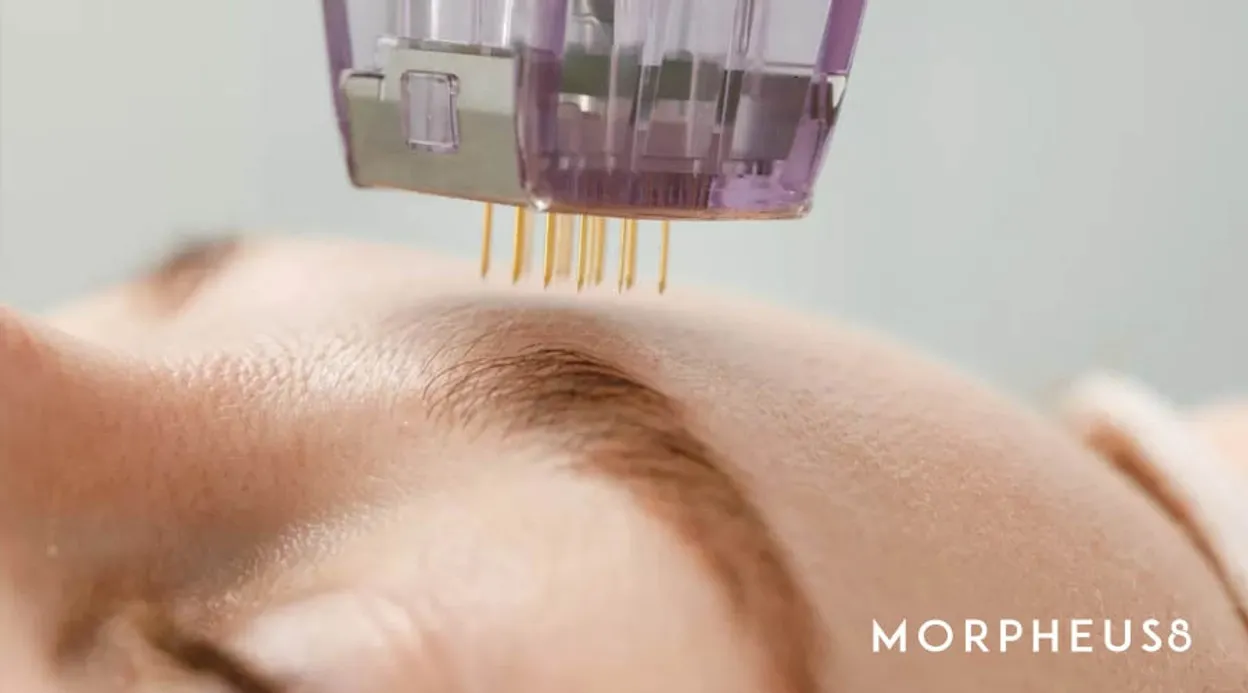
Each needle is a gold-coated electrode, insulated along its whole length except for the final 0.5 mm at the tip. That insulation is the design. Current cannot escape into the tissue the needle passed through on the way down. It can only discharge from the exposed tip, at whatever depth that tip has reached. The heat therefore arrives as a small, defined zone at the bottom of the needle tract, and the surface of the skin is largely spared.
A motor and actuator push the electrodes to a preset depth. Radiofrequency is then delivered between pin pairs at 1 MHz, with a maximum output of 65 W. The manufacturer’s operator manual states that energy reaches less than 5 percent of the total coverage area, producing localised heating and coagulation of the tissue in direct contact with the needle tip, and credits the untreated tissue in between with faster healing.
So the puncture is not really the treatment. The puncture is how heat reaches a depth it otherwise could not. Surface radiofrequency devices have to push energy through the epidermis to warm anything underneath, which limits how hot deeper tissue can safely get. Putting the electrode where you want the heat removes that ceiling.
What the heat is meant to do
The stated mechanism is thermal. Peer-reviewed description of the device puts the target at roughly 50 degrees Celsius in the soft tissue while the skin surface stays at 40 to 42 degrees. At that soft tissue temperature, the literature reports induction of collagen and elastin production, along with angiogenesis, the growth of new small blood vessels.
Two caveats belong immediately next to that paragraph.
The first is that the description comes from a review article, not from a study that measured it in Morpheus8-treated tissue. No quantitative histology specific to this device, showing how much collagen or elastin remodelling occurs and at what depth, has been published. The mechanism is plausible and consistent with what is known about thermal injury in skin generally. It has not been demonstrated for this machine.
The second is that heat at depth is not selective. It coagulates whatever it reaches. In the dermis, that is the intended target. Below the dermis, at the depths this device can reach, it finds subcutaneous fat, and coagulated fat does not reliably come back.
Depth is the entire argument
Every competing radiofrequency microneedling device does roughly what is described above. What sets Morpheus8 apart is how far down it goes.
| Device | Needle depth |
|---|---|
| Morpheus8, manufacturer’s manual | 1 to 7 mm |
| Morpheus8, FDA clearance summary | up to 4.0 mm |
| Potenza | up to 4.0 mm |
| Genius RF | 0.5 to 3.5 mm |
| Secret RF | 0.5 to 3.5 mm |
| Vivace | 0.5 to 3.5 mm |
| SkinPen, plain microneedling | 2.5 mm maximum, not evaluated above 1.5 mm |
Add about 1 mm to any Morpheus8 figure for the thermal effect, which extends roughly a millimetre beyond where the needle physically stops.
Notice the discrepancy inside that table, because clinics rarely mention it. The manufacturer’s manual offers up to 7 mm. The FDA clearance summary for the original Morpheus8 clearance states a maximum treatment depth of 4.0 mm. Both documents are genuine. The manual adds that settings above 4 mm are intended for areas where subcutaneous fat is 1 cm thick or more, which tells you plainly what those settings are reaching.
In published clinical practice, facial treatment runs at 1 to 2 mm and body treatment at 3 to 4 mm, which is most of the difference between a face and a body session. Depth is always paired with energy, and skin tone constrains both: the FDA clearance restricts energies above 62 mJ per pin to Fitzpatrick skin types I to IV.
The tips, and what each is for
| Tip | Pins | Depth | Intended use |
|---|---|---|---|
| Prime | 12 | 1 to 4 mm | Small areas awkward to manoeuvre around |
| Standard | 24 | 1 to 7 mm | Dermal and subdermal treatment |
| Resurfacing, or T tip | 24 blunt, uncoated | Fixed 0.5 mm | Superficial, epidermal treatment |
| Body | 40 | 2 to 7 mm | Large body areas |
The Resurfacing tip is the outlier, and worth understanding because it is not doing the thing described above at all. Its pins are blunt and uncoated, depth control is disabled, and energy is capped lower. It treats the surface.
What the clearance actually covers
Here the marketing and the paperwork diverge sharply.
Morpheus8 has never been FDA approved. It is 510(k) cleared, a different and much lower bar, in which a manufacturer demonstrates that a device is substantially equivalent to one already on the market. Clearance is not a finding that a device works for a cosmetic purpose, and the gap between the two words is the most consequential thing to understand about this treatment.
The current cleared wording, granted in 2023, is that the system is intended for use in dermatologic procedures where coagulation or contraction of soft tissue, or haemostasis, is needed. Haemostasis means stopping bleeding.
Now read that against what the treatment is sold for. No Morpheus8 clearance mentions wrinkles, skin tightening, acne scars, cellulite, stretch marks, body contouring or fat reduction. Not one of them.
A further detail from the 2023 clearance rarely surfaces. The expanded soft tissue wording was supported by bench data from ex vivo pig muscle and fat, carried over from an earlier clearance. The clearance summary records clinical performance data as: not applicable. No clinical trial data were submitted for that indication at all.

Why the same depth cuts both ways
The case for this device is depth. So is the case against it.
In October 2025 the FDA issued a safety communication covering radiofrequency microneedling as a class, reporting burns, scarring, fat loss, disfigurement, nerve damage and the need for surgical repair. The most quoted line from it is also the flattest: radiofrequency microneedling is a medical procedure, not a cosmetic treatment.
The independent systematic review names the largest single risk factor plainly, and it is not the machine. It is user error.
Independent surgical literature had already pointed the same way. A 2025 retrospective review of 180 face and neck lifts, by authors declaring no industry funding and no conflicts of interest, named Morpheus8 specifically, describing contour irregularities related to greater subcutaneous fat loss in areas corresponding to where needles had penetrated. Prior treatment made subsequent surgical correction substantially harder.
The manufacturer’s own manual is equally direct. It states the equipment is for use only by qualified medical professionals trained in the technique, that radiofrequency energy can cause injury if used improperly, and that the higher the energy applied, the greater the possibility of unintended thermal damage. It instructs operators to use the lowest output setting necessary, and to perform a test spot before a first full session.
What this means when you are choosing
None of this means the technology does nothing. It means the honest description is narrower than the advertised one. Morpheus8 puts controlled heat into the dermis, and at higher settings below it, through insulated needle electrodes, and tissue responds to that injury. The depth is genuine and unusual. The regulatory position is that it coagulates and contracts soft tissue, which is a real and specific claim, and not the same thing as any of the cosmetic outcomes it gets sold for.
If you are considering it, the useful questions are mechanical rather than aspirational. What depth on which area, and why. What energy level, and how it has been adjusted for your skin type. Who is holding the handpiece, and what they are trained in. Book a consultation with us and we will answer all three in plain numbers, alongside an honest view of whether this is the right tool for what is bothering you, or whether something else would serve you better.
At a glance
The technology itself, weighed honestly
+ Reasons in favour
- The depth is real and genuinely unusual. The manufacturer's manual offers 1 to 7 mm with roughly 1 mm of additional thermal effect, where Genius RF, Secret RF and Vivace all top out around 3.5 mm
- Insulating every needle except the final 0.5 mm at the tip concentrates heat where the tip sits rather than along the whole needle tract, which is why the surface of the skin is largely spared
- Energy reaches less than 5 percent of the treated area at a time, so untreated tissue is left in between, and the manufacturer's manual credits that gap with faster healing
− Reasons for caution
- No Morpheus8 clearance names wrinkles, skin tightening, acne scars, cellulite, stretch marks or fat reduction. The cleared wording covers coagulation or contraction of soft tissue and stopping bleeding
- The 2023 expansion of that cleared wording was granted on bench data from ex vivo pig tissue. The clearance summary records clinical performance data as not applicable
- The depth that makes the device distinctive is also the source of its distinctive harm. The FDA's October 2025 safety communication lists fat loss, nerve damage and scarring among reported outcomes
Frequently asked questions
The short version.
01Is Morpheus8 FDA approved?
No. It is 510(k) cleared, which is a different and considerably lower bar. Clearance means the manufacturer showed the device is substantially equivalent to one already on the market. It is not a finding that the device works for any cosmetic purpose. Morpheus8 is regulated as a Class II electrosurgical cutting and coagulation device, and the current cleared wording covers dermatologic procedures where coagulation or contraction of soft tissue, or haemostasis, is needed. Any clinic advertising it as FDA approved is stating something untrue.
02How deep does Morpheus8 actually go?
It depends which document you read. The manufacturer's operator manual offers needle depths from 1 to 7 mm depending on the tip, with roughly 1 mm of additional thermal effect beyond where the needle stops, so a 4 mm setting heats to around 5 mm. The FDA clearance summary for the original Morpheus8 clearance states a maximum treatment depth of 4.0 mm. In published clinical practice, facial treatment runs at 1 to 2 mm and body treatment at 3 to 4 mm.
03What is the difference between Morpheus8 and ordinary microneedling?
Ordinary microneedling is purely mechanical. Needles create controlled micro-injury, the body mounts a wound-healing response, and no heat is involved. Morpheus8 does that and then adds a separate thermal injury, delivered as radiofrequency energy discharged from the exposed tip of each insulated needle at a depth the practitioner selects. They are regulated as different classes of device, and the deeper one carries a different risk profile.
04Does the heat damage the surface of my skin?
The design is intended to avoid that. Each needle is insulated along its length except for the final 0.5 mm, so current can only discharge at the tip rather than along the tract it passed through. Published description of the mechanism puts the soft tissue target at roughly 50 degrees Celsius while the skin surface stays at 40 to 42 degrees. That said, burns and scarring appear in both the manufacturer's own list of possible adverse events and in the FDA's 2025 safety communication, and the independent review literature names user error as the largest single risk factor.
05Is the newer Burst version deeper?
Nobody outside InMode can say. Burst and Burst Deep are marketed as delivering radiofrequency to multiple depths and energy levels within a single pulse, but InMode does not publish numeric depths for the Burst range, and no peer-reviewed clinical study specific to Burst has been published. If a clinic quotes you Burst depth figures, it is fair to ask where they came from.